


Conversion and checkout · UX/UI pattern guide
Progressive checkout
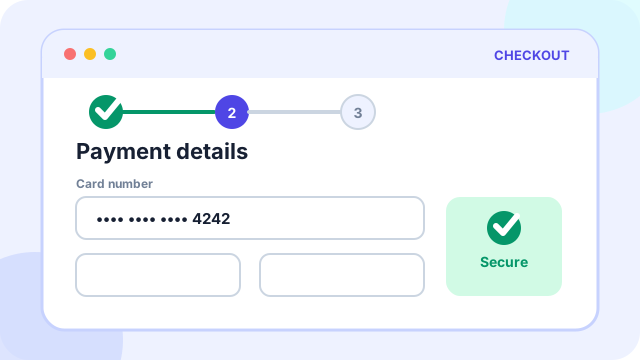
Progressive checkout divides a commitment into understandable stages, validates each stage, and keeps the order, cost, and remaining work visible.
At a glance
What the pattern is designed to accomplish
Step-by-step checkout, validation, delivery/payment sections, and trust markers.
Planning price
€1,500
A starting budget anchor before discovery and technical scoping.
Typical effort
5-9 days
The implementation range depends on states, data, and integrations.
Pattern family
Conversion and checkout
Use the family to find adjacent patterns that support the same journey.
Use cases
When this pattern is a strong fit
Use the pattern when it removes a real decision or interaction burden, not simply because users recognize its visual form.
Best suited to
- Purchases requiring contact, delivery, payment, consent, or review details
- Applications and bookings with several dependent decisions
- High-stakes submissions where a final confirmation reduces errors
Anatomy
The essential parts of progressive checkout
The visual treatment can change, but these responsibilities need to remain clear.
Part 1
A concise progress model with meaningful step names
Define this part explicitly in the design and test it with realistic content and states.
Part 2
Grouped fields that match the user's mental model
Define this part explicitly in the design and test it with realistic content and states.
Part 3
Inline validation and summaries of completed steps
Define this part explicitly in the design and test it with realistic content and states.
Part 4
A final review with total cost, terms, and the exact commitment action
Define this part explicitly in the design and test it with realistic content and states.
Implementation
Design and delivery guidance
The pattern works when interaction rules, content, data, and edge cases support the same user goal.
Recommended approach
- Reduce fields before optimizing their visual arrangement.
- Support guest completion unless an account is essential.
- Preserve entered data and make backward navigation safe.
Common failure modes
- Forcing registration before users can understand the commitment
- Splitting a short form into unnecessary steps
- Using vague final buttons such as Continue when the action creates a charge
Accessibility
Inclusive design requirements
Accessibility is part of the pattern's behavior and content model, not a visual pass added after implementation.
Minimum considerations
- Identify the current step in text and page metadata.
- Move focus to a useful heading or error summary after step transitions.
- Associate every error with its field and preserve values after validation.
History
How progressive checkout emerged and who popularized it
Interface patterns usually evolve through several technologies and products. The distinction below avoids assigning a single inventor where the evidence points to gradual adoption.
Origins
How the pattern came about
Online checkout adapted paper order forms and point-of-sale sequences to the browser. As ecommerce grew, teams experimented with long pages, multi-page wizards, accordion flows, saved credentials, and faster repeat purchasing.
Popular adoption
Who helped make it mainstream
Amazon's 1-Click system, first offered in 1997 and patented in 1999, made friction reduction a competitive strategy. Usability research from practitioners and Baymard helped establish guest checkout, fewer fields, clear progress, and reviewable steps as modern norms.
History and practice sources
Related patterns
Continue through the pattern library
Adjacent patterns often need to be designed as one journey rather than as isolated components.
Conversion and checkout
Shopping cart and order summary
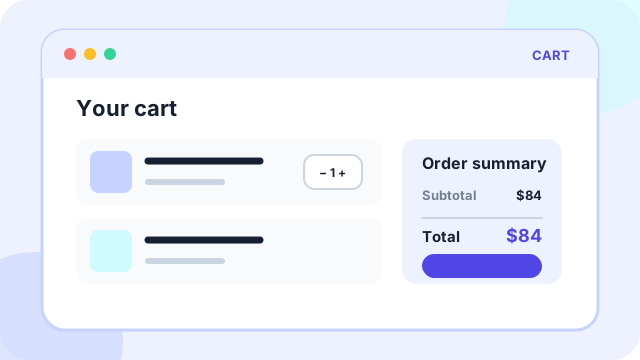
Persistent cart, quantity controls, subtotals, saved choices, and review step.
Read the pattern guideConversion and checkout
Pricing/package selector
Conversion and checkout
Product detail object page
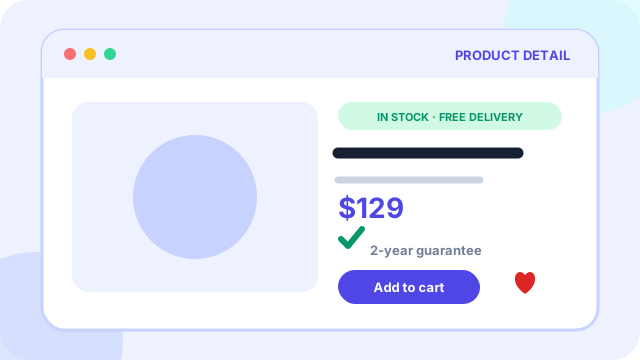
Image gallery, benefits, specifications, trust cues, add-to-cart, and ask-AI decision support.
Read the pattern guide