HAAM Index / Systems
Math Is the Invisible Material of Design
From grids and motion to probability, optimization, and AI, design turns mathematical relationships into things humans can see, use, and trust.
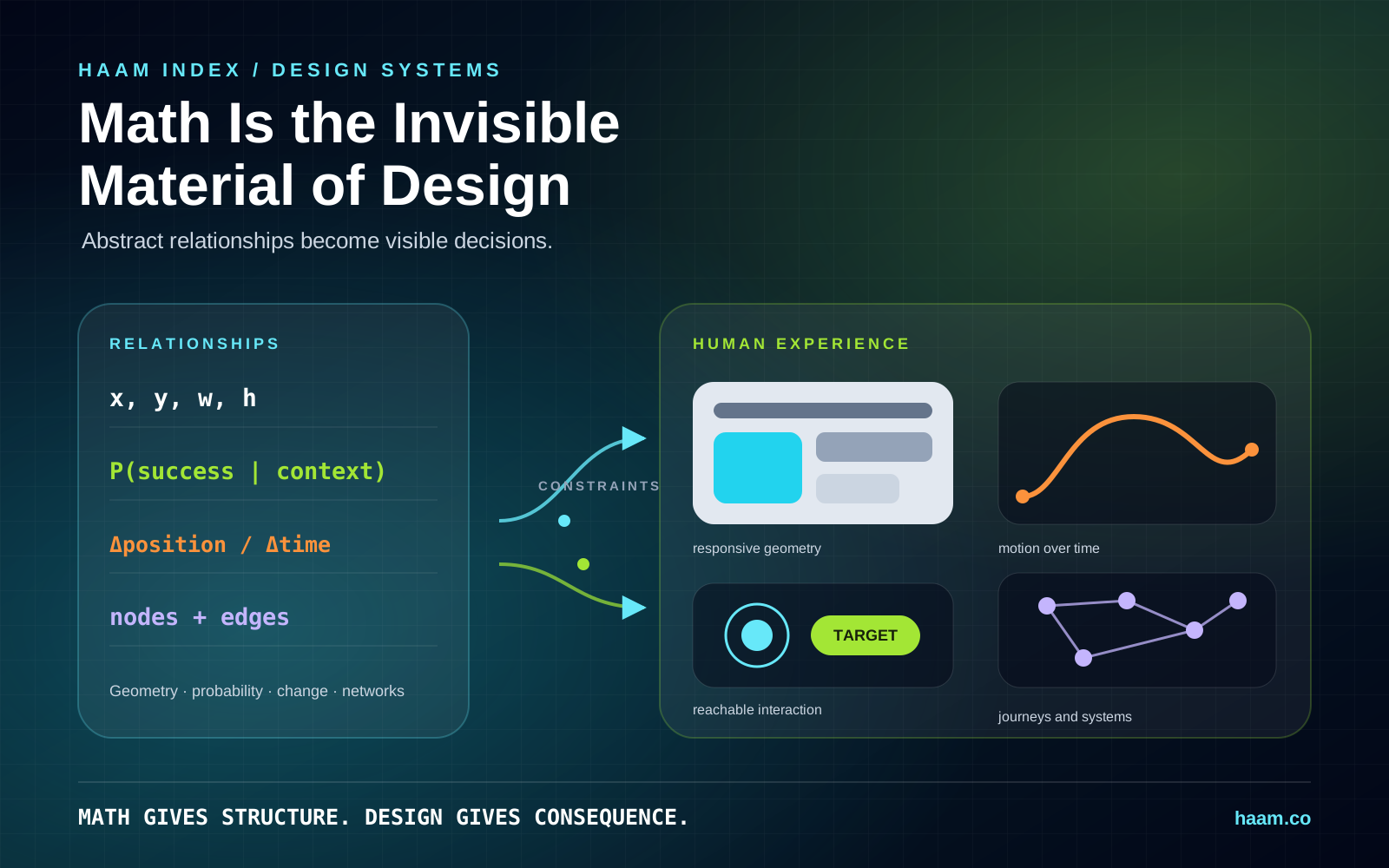
Geometry makes composition responsive rather than fixed.
Statistics separates a useful signal from a persuasive accident.
Optimization becomes design only when someone has to live with the result.
design = relationships + constraints + consequences
You are already using math
Design looks soft from the outside: color, typography, mood, taste. Underneath, it is full of hard relationships.
Every button is a rectangle inside another rectangle. Every animation is a position changing through time. Every research result is a claim about a population made from a sample. Every AI interface is a probability distribution wearing a conversation.
Most designers do not need to solve equations by hand. But they constantly work with proportion, distance, uncertainty, feedback, optimization, and change.
The useful question is not whether design contains mathematics. It is whether we can see the mathematics clearly enough to use it on purpose.
position = f(space, content, rules)
Geometry decides where things can exist
A layout is a coordinate system. It defines where objects begin, how far they may expand, and what happens when space runs out.
Margins, columns, line lengths, target sizes, icon bounds, screen ratios, and responsive breakpoints are all geometric decisions. Even an apparently expressive composition depends on measurements that keep its parts from collapsing into one another.
A mobile interface is not a smaller desktop page. It is the same system solving a different spatial problem.
Geometry becomes especially visible in accessibility. A control must not only look balanced. It must occupy enough physical area to be found, reached, and activated.
sizeₙ = base × ratioⁿ
Ratios turn separate choices into a system
A design system is not a bag of good-looking numbers. It is a set of relationships.
If body text is 16 pixels, a heading might be 24, 32, or 48. If the base spacing unit is 8, the interface can grow through 8, 16, 24, 32, and 48. The individual values matter less than the rhythm connecting them.
Ratios reduce arbitrary decisions. They help a product feel as if its parts belong to the same world.
The golden ratio is not a magic spell. A coherent scale works because it makes decisions relational, not because one number has mystical authority.
card = min(max, container − gaps)
Algebra is what makes a design responsive
A fixed mock-up says: this card is 320 pixels wide.
A responsive system says: the card width equals the available container width minus the surrounding gaps, until a maximum readable width is reached.
That is algebra, even when it appears as CSS rather than notation.
Once a design is expressed as rules, it can adapt to language length, viewport size, user preferences, content density, and new components. The designer stops drawing one answer and starts defining a family of possible answers.
confidence ≠ certainty
Statistics tells us whether people actually understood
Research produces stories, observations, and numbers. Statistics helps us avoid turning a small amount of evidence into a large amount of confidence.
A conversion increase from 12 percent to 14 percent may be meaningful, or it may be random variation. A satisfaction average may hide two completely different groups. A successful task rate may conceal the fact that users needed three attempts.
Good design research uses quantitative evidence to understand scale and qualitative evidence to understand meaning.
Math does not replace human interpretation. It prevents interpretation from pretending to be certainty.
P(success | context)
Probability designs for uncertain humans
People forget passwords, change their minds, tap the wrong control, lose connectivity, misunderstand labels, and behave differently from what they predicted about themselves.
That means design is rarely about guaranteeing one path. It is about shaping the probability of many possible paths.
Onboarding tries to increase the probability of a first success. Error prevention tries to reduce the probability of an irreversible mistake. Trust design tries to reduce the probability that uncertainty becomes abandonment.
An interface becomes more humane when it assumes that variation is normal rather than treating every deviation as user failure.
journey = nodes + edges
Graph theory reveals journeys and dead ends
A product can be represented as a graph.
Screens, states, people, or services become nodes. Actions and transitions become edges. A dead end is a node with nowhere useful to go. A confusing journey may have too many competing edges. A hidden feature may be several steps farther away than the team realizes.
This perspective is useful for navigation, service design, transit systems, marketplaces, social products, and organizational workflows.
Sometimes the visual layer is not the problem. The underlying graph is.
best design ≠ maximum of one metric
Optimization is the real design job
Design almost never has a single objective.
A team may want an interface to be beautiful, fast, accessible, profitable, secure, familiar, expressive, and easy to maintain. Improving one variable can damage another.
More animation may increase delight but reduce performance. More options may increase flexibility but reduce clarity. Stronger security may reduce risk while adding friction.
Design is multi-objective optimization with human consequences. The goal is not to maximize everything. It is to choose which trade-offs are acceptable, for whom, and under what conditions.
velocity = Δposition / Δtime
Calculus is why motion feels alive
Animation is not simply an object at point A and then at point B. It is position changing through time.
Velocity describes how quickly that position changes. Acceleration describes how quickly the velocity changes. Easing curves shape both.
A linear transition can feel robotic because every moment has the same speed. A well-shaped curve can suggest weight, intention, resistance, urgency, or calm.
Users rarely see the function. They feel its derivative.
clarity = signal / noise
Information theory is clarity under noise
Every interface is a communication channel.
The system has a state. The interface encodes that state into words, colors, sounds, shapes, and motion. The user tries to decode it while surrounded by distraction, ambiguity, memory limits, and competing signals.
Grouping reduces noise. Redundancy can prevent errors. Progressive disclosure controls how much information arrives at once. A clear label reduces the number of interpretations the user must consider.
Minimalism is not the removal of information. It is the removal of information that does not help the message survive the channel.
experience = ranking(data, objectives)
Algorithms are now designing with us
When a feed ranks posts, a map chooses a route, a marketplace recommends a seller, or an AI generates an answer, a mathematical model is making part of the design decision.
The interface may show the result, but the experience is shaped earlier by scoring functions, thresholds, training data, confidence estimates, and optimization targets.
This is why algorithmic products cannot separate design ethics from technical logic. A beautifully presented ranking can still encode a harmful objective.
The algorithm is not behind the design. It is inside the design.
structure + judgment = design
Math gives structure. Design gives consequence.
Mathematics asks which relationships must hold for a system to work.
Design asks which relationships must hold for a system to make sense to a person.
Math can describe a curve, but design decides whether that curve feels calm or impatient. Math can optimize a conversion rate, but design decides whether the optimization respects the user. Math can rank possibilities, but design decides which values were allowed to become objectives.
The point is not to turn every designer into a mathematician. It is to notice the invisible material already being shaped.
Design is mathematics made perceivable, negotiable, and human.
reference layer
Sources and further reading
- W3C, CSS Grid Layout Module Level 1
- W3C, Understanding Success Criterion 2.5.8: Target Size (Minimum)
- Material Design 3, Motion overview
- Paul M. Fitts, The Information Capacity of the Human Motor System in Controlling the Amplitude of Movement
- Claude E. Shannon, A Mathematical Theory of Communication