


April 2019 archive · Published July 6, 2026 · 8 min read
Waste ID at Hack for Sweden 2019
A field note from my participation in the Waste ID team at Hack for Sweden 2019, where we prototyped a QR-based identity layer for discarded products.
Before a material can circulate, a system has to know what it is.
In April 2019, I joined the Waste ID team at Hack for Sweden in Stockholm. We worked on a simple systems question: what would happen if discarded products did not become anonymous the moment they entered a bin?
Our concept gave an item a unique digital identity and made that identity accessible through a QR code. The prototype turned a circular-economy proposition into something that could be generated, scanned, discussed, and challenged inside the hackathon room.
What survives in the archive
A concept paper, a generator, and evidence from the floor
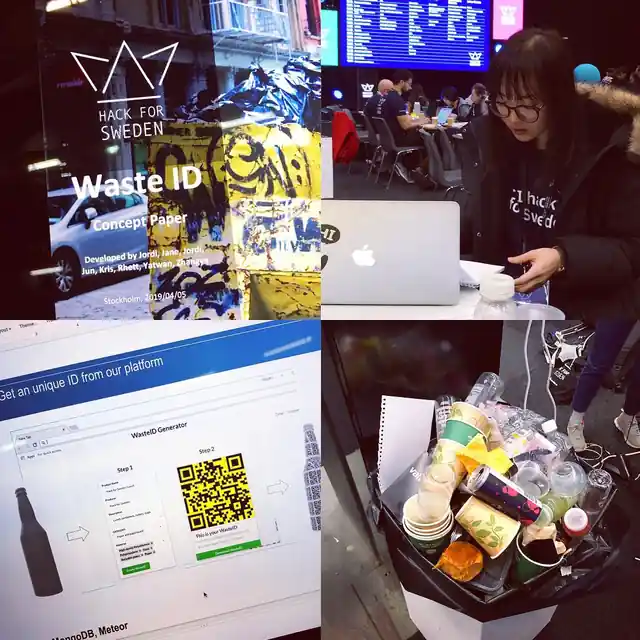
Hackathons often leave fragments rather than a finished institutional record. These fragments show the project at several levels: the title and team on the concept paper, the interface producing a Waste ID, and the mixed disposable objects that made the problem immediate.
Concept
Waste ID
The surviving concept-paper cover records the project name, the Hack for Sweden setting, and the Stockholm date of April 5, 2019.
Prototype
QR identity generator
The interface shown in the archive creates a unique Waste ID from product information and returns a scannable QR code.
Team
Eight contributors
The concept-paper cover credits an eight-person team, including me. Waste ID was collaborative work developed under hackathon conditions.
The Waste ID proposition
Give the physical thing a digital memory
Waste systems encounter objects after their original commercial story has ended. Packaging has lost its shelf context, products have lost their documentation, and materials arrive mixed together. The information needed for the next decision is often incomplete or inaccessible.
A Waste ID creates continuity. The identifier can connect the physical object to material composition, product type, manufacturer information, repair guidance, recycling instructions, and later handling events. The QR code is the visible doorway into that record.
Identify the object
A product enters the waste stream with material properties and manufacturing history that are often invisible at the moment of disposal.
Connect the record
A unique identifier can link the physical object to composition, origin, repair, reuse, recycling, and handling information.
Support the decision
The record becomes useful when a consumer, municipality, recycler, or manufacturer can retrieve it and choose a better next action.
Preserve the history
A persistent identity can record what happens later, turning waste from an anonymous endpoint into a traceable process.
What the prototype made visible
Traceability is an interaction-design problem
A database becomes useful when people can enter reliable information, understand what the identifier represents, retrieve the record at the right moment, and act on it without specialist training.
Every field in the generator was therefore a design decision. Which facts belong to the identity? Who provides them? What happens when the data is missing or wrong? How can a recycler, consumer, municipality, and manufacturer read the same record while understanding their different responsibilities? The interface sits between environmental intention and operational reality.
The value of the hackathon room
Compression forces the system to become concrete
A hackathon compresses research, negotiation, design, implementation, and presentation into the same short period. The format removes distance between a policy ambition and the interface someone would actually use.
The useful work in the Waste ID team included reaching enough shared understanding across different people to decide what the QR code should mean. The prototype became a temporary agreement about the boundaries of the problem.
Physical collaboration gives a concept contact with other minds, practical constraints, limited time, and the obligation to show something at the end. The surviving collage records that moment of collective concentration.
A line through later work
Sustainability needs interfaces that preserve consequences
Waste ID belongs to an older line in my work that later continued through Green Filter and life-centered design. The recurring question is how a product can make consequences visible at the moment a person or institution has the power to choose.
Sustainability becomes operational when a system can identify the thing, connect it to evidence, assign responsibility, and support a better next action. That requires data, accessibility, performance, trust, and a clear interface.
Archive boundaries
What this note claims, and what it does not
The photograph documents my participation in the Waste ID team, the project name, the Stockholm date on the concept paper, a working generator screen, and the physical context of the event.
I am not claiming that Waste ID won the hackathon, became a deployed public system, or belonged to any one contributor. The artifact records a team trying to make waste legible enough for a better system to begin.