

July 3, 2026 · 10 min read
The Prompt Is Not the Product
AI is moving beyond the empty chat box. The durable product is the system that gathers context, generates instructions, evaluates results, controls permissions, and turns answers into work.
Early AI products gave users a blank box and made them responsible for operating the model. They had to explain the task, find the right wording, paste the context, notice errors, and move the answer into another tool.
Prompt engineering improved that experience, but it did not remove the underlying burden. It mainly taught people to perform more of the system's work themselves.
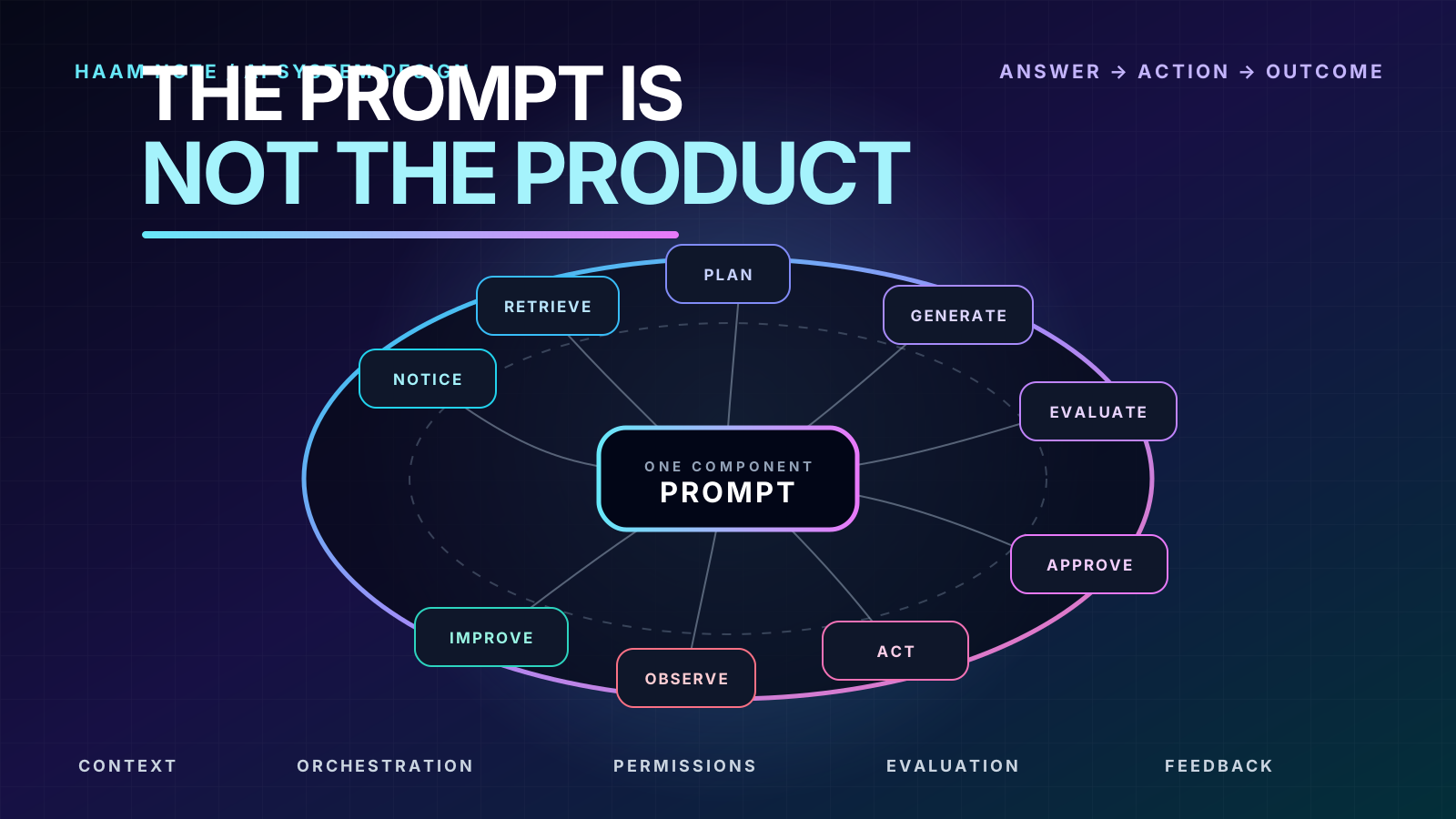
The next step is not a larger prompt library. It is a product that understands the work around the prompt: what triggered the task, which information matters, which instructions should be generated, how the result should be checked, who may approve it, and what action should follow.
The prompt is becoming an internal implementation detail. The product is the system that decides what to ask, when to ask it, and what to do with the answer.
Explore the operating loop
The system decides what to ask, then uses the answer.
Select a stage to see what exists around the model call. The prompt is only one step in a much larger product.
01 / Notice
What changed?
A useful system starts with a signal, not an empty chat box. The signal might be a new support request, a conversion drop, a repeated customer question, an upcoming event, or a change in product data.
- Input
- Event, request, anomaly, schedule, or human instruction
- System decision
- Is this important enough to start a workflow?
- Generated instruction
- Classify the signal by type, urgency, affected audience, and required response.
- Control
- Ignore low-value noise and preserve a trace of why the workflow started.
Two different product models
From prompt-written AI to system-designed AI
Starting point
Prompt product
An empty text box
System product
A real signal, goal, or recurring event
Context
Prompt product
The user manually pastes it
System product
The product retrieves permitted, relevant evidence
Instructions
Prompt product
One reusable prompt template
System product
Task-specific instructions assembled at runtime
Quality
Prompt product
The user notices mistakes
System product
Outputs are checked against evidence and rules
Action
Prompt product
Copy and paste the answer elsewhere
System product
Approved results update the tools where work happens
Learning
Prompt product
Start over next time
System product
Outcomes and corrections improve the workflow
The moat moved outward
Better wording is useful. The durable advantage lives around the model.
Prompts are easy to copy, models can be replaced, and yesterday's clever technique can become tomorrow's default feature. A defensible AI product is more likely to come from proprietary context, trusted integrations, accumulated evaluation data, permission design, workflow knowledge, and feedback from real outcomes.
This also changes what teams should optimise. The question is no longer only, “How do we get a better answer from the model?” The more useful question is, “How do we build a dependable operating loop in which models can be replaced, compared, constrained, and improved?”
What HAAM designs
Six layers around the model call
The model is one replaceable component. HAAM focuses on the layers that turn it into a usable, supervised, and maintainable product.
01
Context
The system retrieves the smallest useful set of customer history, analytics, documents, product data, prior decisions, and external evidence.
02
Orchestration
It decides which task happens next, which model or tool should perform it, and when another route is more reliable.
03
Evaluation
It checks whether the result is supported, complete, structured correctly, and suitable for the risk of the task.
04
Permissions
It separates reading, drafting, approving, sending, publishing, spending, record changes, and deletion into explicit boundaries.
05
Interface
It gives people ways to inspect context, correct assumptions, compare alternatives, approve actions, and recover from failure.
06
Observability
It records cost, latency, confidence, failures, human corrections, outcomes, and the value created by each run.
Example: HAAM Signal Agent
One opportunity brief may require a whole chain of generated instructions.
Imagine an agent looking for recurring user problems that could become products, services, or editorial opportunities. It does not run one giant prompt and hope for insight.
It collects signals from customer requests, analytics, public discussions, research notes, and events. It groups similar problems, checks whether they recur, retrieves related evidence, compares them with existing offers, drafts an opportunity hypothesis, scores confidence and risk, and prepares a review packet.
- 01Identify the affected audience and repeated problem.
- 02Retrieve related evidence and previous observations.
- 03Generate research questions for missing information.
- 04Compare the signal with existing products and offers.
- 05Draft a possible intervention and testable hypothesis.
- 06Score evidence quality, confidence, risk, and urgency.
- 07Ask a person to approve deeper research or action.
- 08Turn the approved signal into an experiment, proposal, article, or product concept.
Each stage creates the context and instructions for the next one. The intelligence is the complete loop.
Explore the HAAM Signal AgentDesign principles
Build something that can use the answer responsibly.
- 01Begin with the outcome and operating conditions, not the model.
- 02Generate prompts from current context instead of asking users to maintain giant templates.
- 03Use deterministic software whenever it is more dependable than generation.
- 04Treat model output as a candidate that must earn the right to become an action.
- 05Expose assumptions, evidence, permissions, and uncertainty at the moment they matter.
- 06Design correction, fallback, and human handoff before automation reaches production.
- 07Measure the result after the action, not only the elegance of the generated answer.
The next generation of AI products will not require everyone to become a professional prompt writer. They will help people express a goal, gather the right context, inspect the result, and safely complete the work.
Put the idea into practice
Design the system before you automate the work.
Map the trigger, context, decisions, generated instructions, evaluation, permissions, actions, and measurable outcomes. Then choose the models and tools that fit each step.