


Systems / Art history / Experience design / Branding
When the exhibition becomes an operating system.
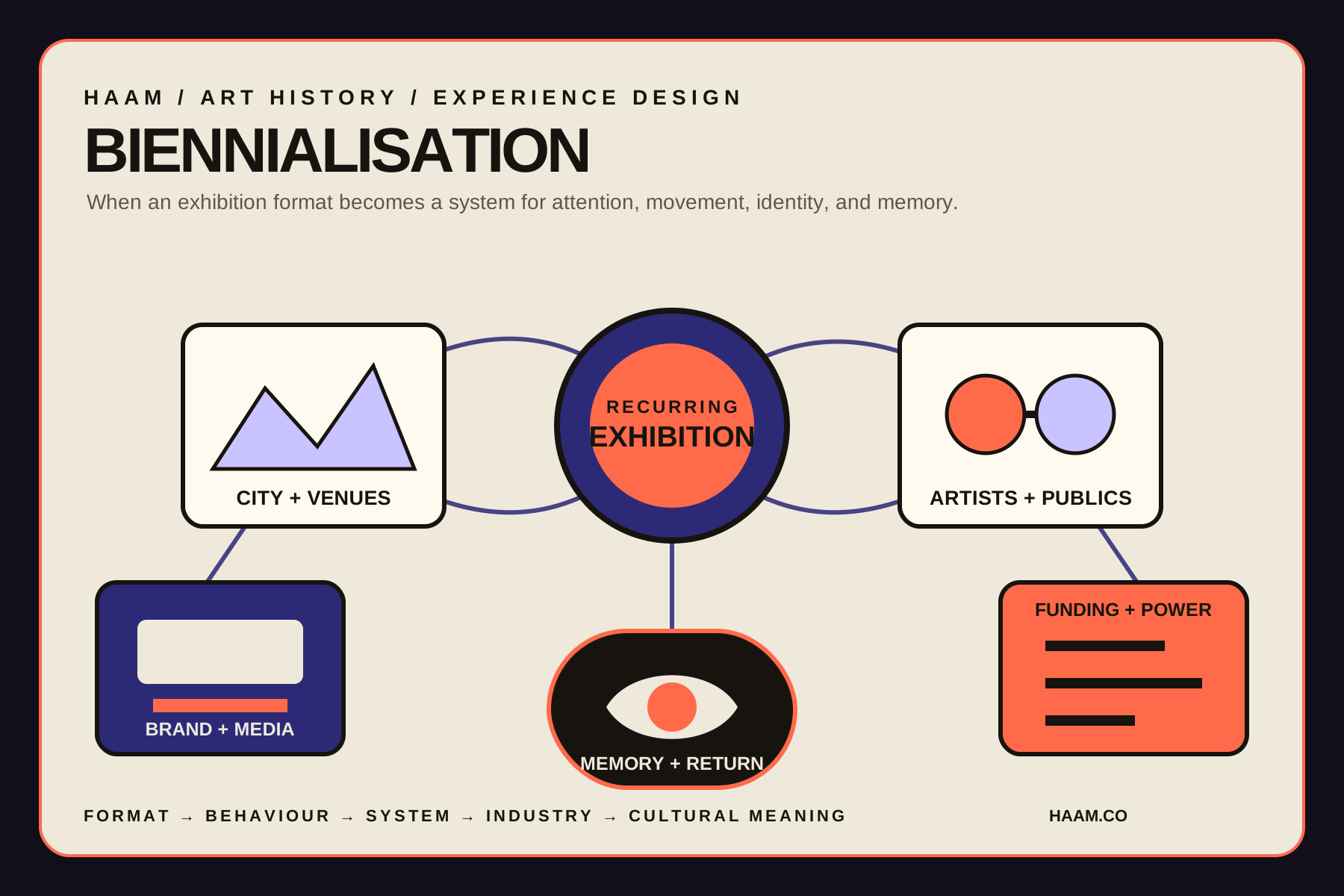
Biennialisation is what happens when the recurring international exhibition stops being only an event format and starts organising how art, cities, institutions, brands, and audiences behave.
Published July 3, 2026 / 14 min read / Kris Haamer
Definition
More events, and more sameness.
01 / Multiplication
The format spreads.
More cities establish recurring international exhibitions to create cultural visibility, connect local scenes to global networks, attract visitors, and demonstrate civic ambition.
02 / Standardisation
The format repeats itself.
Different places begin using similar curatorial language, international artist circuits, industrial venues, visual identities, programmes, and claims of transformation.
Biennialisation names a paradox: the format helps art become more global while making global art events feel increasingly interchangeable.
Art history
Exhibitions do not only show history. They manufacture it.
A recurring exhibition selects a present, gives it a structure, and distributes that interpretation through images, writing, architecture, travel, and professional networks. This makes the biennial an art-historical machine, not a neutral container.
Nineteenth century
01The exhibition becomes a model of the world
World fairs, salons, museums, and international exhibitions learned to compress nations, industries, objects, and ideas into navigable public spectacles. The exhibition was already becoming media, diplomacy, education, and urban theatre at once.
1895
02Venice makes recurrence part of the institution
The first International Art Exhibition in Venice established the durable premise behind the biennial: contemporary culture would return on a rhythm, gather international attention, and become attached to the identity of a city.
Postwar decades
03Temporary exhibitions gain art-historical authority
Recurring exhibitions increasingly did work once associated with museums and textbooks. They selected artists, framed movements, produced canons, and told audiences what the present meant while the present was still unfolding.
Late twentieth century
04The format travels and is contested
New biennials developed outside the oldest European centres. Some reproduced the Venice model. Others challenged national pavilions, Eurocentric selection, and the assumption that global art needed to pass through the same institutions.
The biennial boom
05A format becomes global infrastructure
Cities adopted biennials as tools for cultural visibility, tourism, regeneration, diplomacy, and local scene-building. Curators, artists, funders, journalists, and audiences began moving through a recurring international circuit.
Now
06The exhibition behaves like a platform
A biennial can include commissions, talks, publications, education, digital archives, neighbourhood routes, hospitality, partnerships, and public debate. The event is temporary, but the operating system around it can shape a city for years.
Experience design
The visitor does not experience the curatorial concept. They experience a journey.
The official theme may be sophisticated, but the lived edition is made from websites, trains, queues, thresholds, maps, toilets, conversations, tired feet, unexpected rooms, and the final image someone remembers.
Experience equation
Promise + route + encounter + context + social energy + afterlife
01
Expectation
The experience begins with the theme, identity, artist list, press images, ticketing, social media, and rumours. Before anyone arrives, the biennial has already designed a mental model of what matters.
02
Orientation
Maps, transport, venue clusters, opening hours, accessibility information, queues, and staff determine whether the city feels legible. Wayfinding is not support material. It is part of the curatorial argument.
03
Traversal
Visitors move between rooms, pavilions, warehouses, streets, cafés, and neighbourhoods. Distance, fatigue, weather, waiting, and surprise become part of how the art is understood.
04
Interpretation
Labels, mediators, audio, architecture, public programmes, and digital layers decide how much context is available and who gets to feel culturally fluent inside the event.
05
Social performance
A biennial is also a place to be seen, meet collaborators, post images, attend openings, and signal membership in a cultural public. The audience is not outside the work. It helps produce the event's meaning.
06
Afterlife
Reviews, photographs, catalogues, archives, friendships, commissions, and local memories continue after the venues close. A strong edition designs what can remain, not only what can open.
Branding
The brand is the recurring promise, not this year's logo.
Biennials expose a branding problem that many organisations share. They need to change enough to remain culturally alive while retaining enough structure to be recognised, trusted, and remembered.
TENSION 01
Global recognition / local specificity
The word biennial creates instant international legibility. The danger is that the city becomes a backdrop for a format that could have landed almost anywhere.
TENSION 02
Edition identity / institutional memory
Each curator and theme may need a new visual language, but total reinvention can erase recognition. The institution needs a stable grammar that can hold changing editions.
TENSION 03
Cultural mission / destination marketing
A biennial can support artists and public debate while also selling hotels, neighbourhoods, sponsors, and civic ambition. Branding becomes credible only when these motives are made coherent rather than hidden.
TENSION 04
Criticality / hospitality
The content may challenge power, borders, extraction, or spectacle. The experience still needs to welcome people, reduce confusion, and care for bodies moving through demanding spaces.
LAYER 1
Institution
The durable name, mission, archive, relationships, and standards.
LAYER 2
Edition
The temporary theme, curator, artists, identity, and public argument.
LAYER 3
City
The places, routes, communities, histories, infrastructure, and civic narrative.
LAYER 4
Audience
The expectations, access needs, participation, interpretation, and memory.
Contemporary connections
Biennialisation does not stop at the biennial.
Its logic now appears in citywide art seasons, luxury cultural strategies, collector foundations, and private museums. The recurring question is who gets to assemble culture into an experience, give it institutional form, and make that interpretation feel authoritative.
01 / City-scale cultural experience
JING DAILYBeijing Art Season: How luxury brands should navigate city-scale cultural events
Beijing Art Season makes the scale shift visible. When hundreds of events and institutions are distributed across a city, the cultural programme becomes a public service journey. Luxury brands are no longer deciding only what to sponsor. They are deciding how to enter an existing cultural ecology without making every encounter feel like branded content.
Experience design connects venues, transport, information, hospitality, neighbourhoods, and attention. Branding becomes a question of cultural behaviour, not logo visibility.
02 / Collecting as institution-building
JING DAILYAsia's next-gen collectors quietly turn region into a private museum powerhouse
The rise of private museums extends the logic of biennialisation beyond temporary events. Collectors do not only acquire objects. Through buildings, foundations, exhibitions, archives, hospitality, and networks, they can create new institutions that influence which artists are seen and how regional art history is written.
Art-historical authority shifts toward private actors. Personal taste becomes architecture, programme, public identity, and long-term brand capital.
For designers and institutions
What other brands can borrow without pretending to be a biennial.
The useful lesson is not to imitate the visual language of contemporary art. It is to understand how a temporary programme can create a durable world through rhythm, participation, place, and memory.
- 01Treat the event as a service journey, not a poster campaign.
- 02Design the city route with the same care as the gallery interior.
- 03Build one recognisable institutional grammar that can survive changing themes.
- 04Make access information part of the main narrative, not a buried utility page.
- 05Give local communities roles beyond providing atmosphere and real estate.
- 06Plan the archive, reuse, relationships, and public value before opening day.
Project connection
Tallinn Biennial
Exhibition identity, ecological thought, public programming, and digital communication treated as one cultural system.
View the project →
HAAM service
Experience Design
Design for exhibitions, events, services, spaces, installations, and the digital touchpoints connecting them.
See the service →
Continue reading
Art History for the Present
More connections between images, institutions, technologies, power, visual culture, and contemporary design.
Open Art History →
Sources and further reading
This page is an interpretive HAAM essay informed by institutional histories, critical writing on recurring international exhibitions, and current reporting on city-scale cultural events and private museums.
- Jing Daily, Beijing Art Season: How luxury brands should navigate city-scale cultural events
- Jing Daily, Asia's next-gen collectors quietly turn region into a private museum powerhouse
- La Biennale di Venezia, History 1895 to 2025
- Biennial Foundation, global directory and research network
- The Biennial Reader, Bergen Kunsthall and Hatje Cantz
- The Manifesta Decade, MIT Press