


HAAM Index / Narrative governance · July 4, 2026 · 12 min read
A Storyworld Is a System of Permission
Who gets to tell, adapt, translate, profit from, or refuse a story? A framework for local storytelling, cultural appropriation, intersectionality, and ethical worldbuilding.
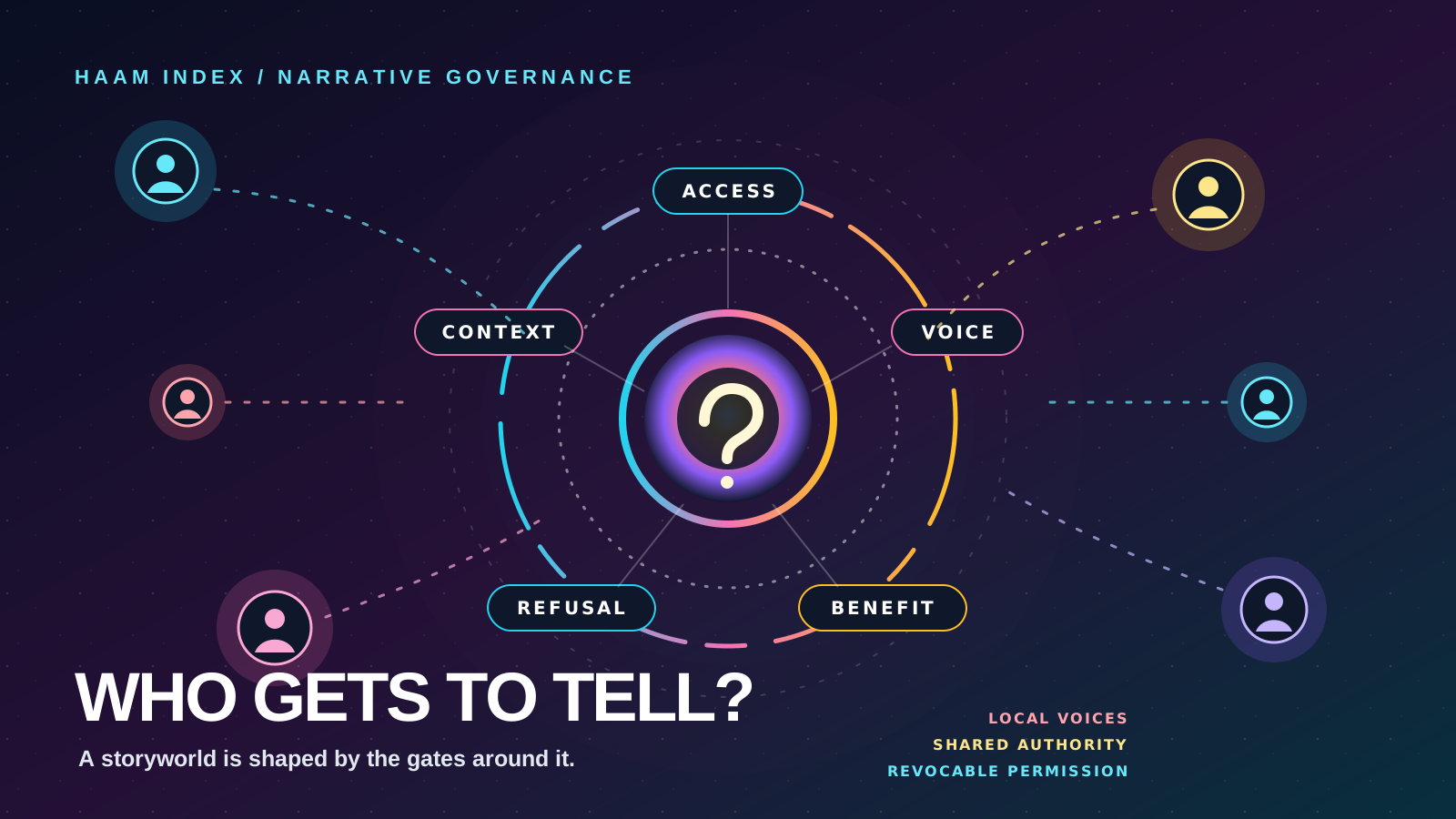
A storyworld is not only a collection of characters, places, rules, and memories. It is also a system that decides who may enter, who may speak, what may travel, and who can turn shared meaning into value.
In The Storyworld Is Older Than the Franchise, I described permission to continue as one of the basic layers of a durable world. That idea needs its own article because continuation is never a purely creative question.
Every retelling takes place inside relationships of law, ownership, language, race, class, gender, colonial history, platform power, and access to distribution. A storyteller may have the technical ability to use a story without having the social permission to claim it, simplify it, expose it, or profit from it.
The goal is not to create a purity test in which only one kind of person can ever write one kind of story. The goal is to replace the fantasy of neutral authorship with a more useful question: what position are you speaking from, and what responsibilities come with it?
Permission is not a legal checkbox added after the story. It is part of the storyworld's architecture.
Six layers of permission
The right to see something is not the same as the right to retell it.
Story teams often collapse permission into copyright clearance. Copyright matters, but it cannot describe all the social rules that surround living culture, community memory, sacred knowledge, family history, or local identity.
01
Access
Who may encounter the material at all?
Public visibility does not automatically mean unrestricted use. A story, image, name, place, ceremony, archive, or dataset can be easy to find while still carrying social, spiritual, familial, or community-specific conditions.
02
Voice
Who may speak from inside the world?
There is a difference between describing a community, collaborating with it, writing a character from it, and claiming to speak as it. The closer a work moves toward authority, the stronger its obligations become.
03
Adaptation
What may be changed, combined, fictionalised, or translated?
Some elements invite reinterpretation. Others depend on exact context, named custodians, language, season, place, gender, initiation, or ceremony. Ethical adaptation starts by learning which differences matter.
04
Circulation
Where may the story travel, and for which audiences?
A story told within a family, village, classroom, performance, or ritual may change meaning when placed on a global platform. Distribution is not neutral. It can detach material from the relationships that made it legible.
05
Benefit
Who receives money, credit, access, status, and future opportunity?
A project can be accurate and still be extractive. Permission is incomplete when local knowledge becomes global value while the people who carried it remain unnamed, unpaid, or replaceable.
06
Refusal
Who can say no, pause the work, remove material, or change the terms?
Consent is not real when it only exists at the beginning. A responsible storyworld includes a continuing path for withdrawal, correction, disagreement, and limits that do not need to be converted into content.
Who is telling the story?
Authorship is a position inside a power system.
Identity matters because lived experience changes what a person can notice, risk, remember, and be held accountable for. Identity alone, however, does not answer every ethical question. A person can belong to a culture while holding unusual privilege inside it. An outsider can build a long, accountable relationship. A local institution can still exploit its own community.
The useful move is to examine position rather than hunt for a perfect spokesperson. Position includes relationship, knowledge, vulnerability, institutional power, intended audience, economic interest, and the ability to repair harm.
01
What is your relationship to the story?
Are you a member, descendant, neighbour, guest, researcher, client, fan, translator, rights holder, or outsider? None of these positions produces automatic moral purity, but each creates different knowledge, blind spots, and duties.
02
Who is the imagined audience?
A local audience may recognise irony, coded language, historical tension, or internal disagreement that an international audience misses. Reframing for outsiders can quietly turn living complexity into explanation, spectacle, or proof.
03
Who carries the risk?
The storyteller may receive praise while represented people face stereotyping, exposure, political pressure, family conflict, harassment, or unwanted visibility. Ethical review follows the risk, not only the byline.
04
Who has editorial power?
Consultation after the concept is fixed is not the same as co-authorship. Look at who can change the premise, budget, casting, language, distribution, marketing, metadata, and final cut.
05
Who can continue the world later?
A project can invite local voices for authenticity and still centralise future ownership elsewhere. Ask who controls sequels, archives, training data, character rights, translations, merchandising, and machine-generated extensions.
Local storytelling
Local does not mean adding culturally specific decoration to a universal plot.
A local story is shaped by who is expected to understand it, which language carries intimacy or authority, how time is felt, what remains unsaid, who may joke about whom, which places hold memory, and which conflicts cannot be separated from history.
Global production systems often preserve visible details while replacing the local logic underneath them. Food, costume, mythology, architecture, and accent survive, but pacing, social obligation, kinship, humour, spirituality, class, and political memory are rebuilt around assumptions imported from elsewhere.
Ethical localisation therefore means more than accuracy. It means letting local people influence the form, not only supply the content. Sometimes the strongest local choice is opacity: a word remains untranslated, a ritual stays off-screen, a conflict is not simplified for visitors, or a community decides that a story should not scale.
Language
Who sounds intelligent, intimate, comic, modern, rural, sacred, or official in each language?
Form
Does the medium preserve local rhythms of telling, listening, repetition, silence, and participation?
Authority
Who is treated as a source, who becomes an author, and who can refuse the final framing?
Cultural appropriation
The problem is not that culture moves. The problem is how power moves with it.
Culture has always travelled through trade, migration, conquest, marriage, translation, religion, performance, imitation, solidarity, and play. A rule against all borrowing would describe neither history nor creativity.
Cultural appropriation becomes a useful concept when it directs attention to asymmetry. Who was punished for practising the culture? Who is now rewarded for packaging it? Who can be mistaken, experimental, or profitable without carrying the social cost attached to the source community?
No single checklist can settle every case. These signals help reveal where inspiration is becoming extraction.
Aesthetic extraction
Extractive pattern
Borrow symbols, clothing, music, language, ritual, or mythology because they look distinctive.
Stronger practice
Understand what the element does, who holds authority around it, and whether it belongs in this context at all.
Context collapse
Extractive pattern
Treat a publicly visible fragment as free-floating creative material.
Stronger practice
Restore its relation to place, history, kinship, belief, conflict, and the conditions under which it is normally shared.
Authority laundering
Extractive pattern
Use one consultant, friend, or performer to validate an entire community or tradition.
Stronger practice
Name the limits of each contributor's authority and make disagreement visible instead of manufacturing a single approved voice.
Unequal reward
Extractive pattern
Offer credit or exposure while ownership, revenue, and future leverage remain elsewhere.
Stronger practice
Design compensation, rights, access, attribution, and long-term benefit into the project before value is created.
Irreversible circulation
Extractive pattern
Publish globally first, then apologise or remove a post after harm appears.
Stronger practice
Use staged release, restricted access, review gates, revocable permissions, and distribution choices that match the material.
Representation asks who appears in the frame. Intersectionality asks how power shapes every position inside it.
Intersectionality
A diverse cast can still reproduce a flat world.
Kimberlé Crenshaw developed intersectionality to show how systems of power can overlap in ways that disappear when race and gender are examined as separate categories. For storyworld design, the lesson is not to attach more identity labels to a character sheet. It is to notice how institutions, risks, freedoms, and ways of being recognised change at the intersections.
A world may celebrate women while centring only wealthy, able-bodied, majority-language women. It may celebrate a national culture while erasing Indigenous people, migrants, rural communities, mixed identities, queer people, or lower-status regions within it. It may invite community input while only hearing those with time, confidence, education, internet access, or institutional approval.
01
Do not design one representative character
No person stands in for a whole culture. Age, class, gender, disability, sexuality, migration, language, religion, region, caste, citizenship, and family position can change how someone encounters the same world.
02
Map power inside the community too
Local is not automatically equal. Communities contain institutions, elites, exclusions, generational conflict, internal borders, and people whose stories are repeatedly treated as less authentic.
03
Follow overlapping consequences
A narrative choice may be harmless for one member of a group and dangerous for another. Intersectionality asks where systems meet, especially where a broad category hides the people carrying the greatest cost.
04
Let contradiction remain
Ethical storytelling does not require a single clean community position. It needs a process capable of holding disagreement without using complexity as an excuse to ignore responsibility.
AI makes permission operational
A generative storyworld can cross a boundary thousands of times before anyone notices.
AI can imitate a visual language, generate dialect, animate sacred imagery, clone a voice, translate a story, extend a character, or personalise a narrative for millions of people. This turns ethical judgement into a systems problem. A good intention in the original prompt cannot govern every future output.
The storyworld needs machine-readable permissions and human-readable accountability: provenance, contributor roles, restricted elements, approved uses, audience conditions, attribution, benefit-sharing rules, review triggers, expiry dates, and a process for removing generated material.
Local Contexts demonstrates one important direction. Its Traditional Knowledge Labels make community-specific rules around provenance, access, circulation, and permission visible within digital systems. The broader lesson is that metadata can carry relationships and responsibilities, not only ownership and file type.
A permission brief for storyworld teams
Design the ethical gates before production makes them expensive to move.
01
Before the concept
Whose world is this, and why are we entering it?
Identify cultural authorities, affected groups, historical power, existing protocols, and areas that may be restricted or inappropriate.
02
Research
What is knowledge, and what is relationship?
Track provenance, distinguish public information from permission, pay local researchers, and document who can authorise which uses.
03
Authorship
Who can alter the premise?
Move relevant collaborators upstream, define editorial power, credit specific contributions, and avoid treating lived experience as a fact-checking service.
04
Production
Where can harm still be stopped?
Create review gates for language, image, sound, casting, interaction, metadata, AI generation, and promotional framing.
05
Release
Does every audience need the same access?
Choose channels, territories, age gates, context notes, community previews, permissions, and commercial terms deliberately.
06
After release
What happens when meaning changes?
Keep a correction path, revenue reporting, revocation process, archive policy, and a named person accountable for future adaptations.
The useful idea to carry forward
An ethical storyworld does not eliminate movement. It makes movement accountable.
Stories should travel. People should imagine beyond their own lives. Translation, adaptation, collaboration, and cultural exchange can create solidarity, surprise, beauty, and futures that no isolated group could make alone.
But openness cannot be the default imposed by whoever has the largest platform. Some worlds contain public invitations. Some require relationship. Some permit learning but not commercialisation. Some allow retelling but reserve certain images, names, performances, or knowledge. Some have the right to remain partially closed.
The mature question is not, "Am I allowed to tell stories about people different from me?" It is, "What relationships, permissions, constraints, shared authority, and continuing responsibilities would make this telling worth doing?"
Sources and further reading
- Kimberlé Crenshaw: Demarginalizing the Intersection of Race and Sex
- United Nations Declaration on the Rights of Indigenous Peoples
- WIPO: Traditional Cultural Expressions
- Local Contexts: Traditional Knowledge Labels
- Global Indigenous Data Alliance: CARE Principles
- UNESCO Universal Declaration on Cultural Diversity
These frameworks do not create one universal permission system. Their value is in showing that culture, knowledge, and data carry relationships that ordinary copyright and open-access language often fail to represent.
Continue through HAAM
From world history to narrative governance and production.
Read the companion history of storyworlds, explore AI-enabled transmedia systems, or work with HAAM on a culturally accountable narrative product.