


Archive begins April 2022 · Published July 3, 2026 · 10 min read
Buildspace and the Feeling That You Could Make Something Good
A personal archive note on Buildspace, the community that treated your own idea as the curriculum, what survives from my participation, and how Green Filter moved into public view.
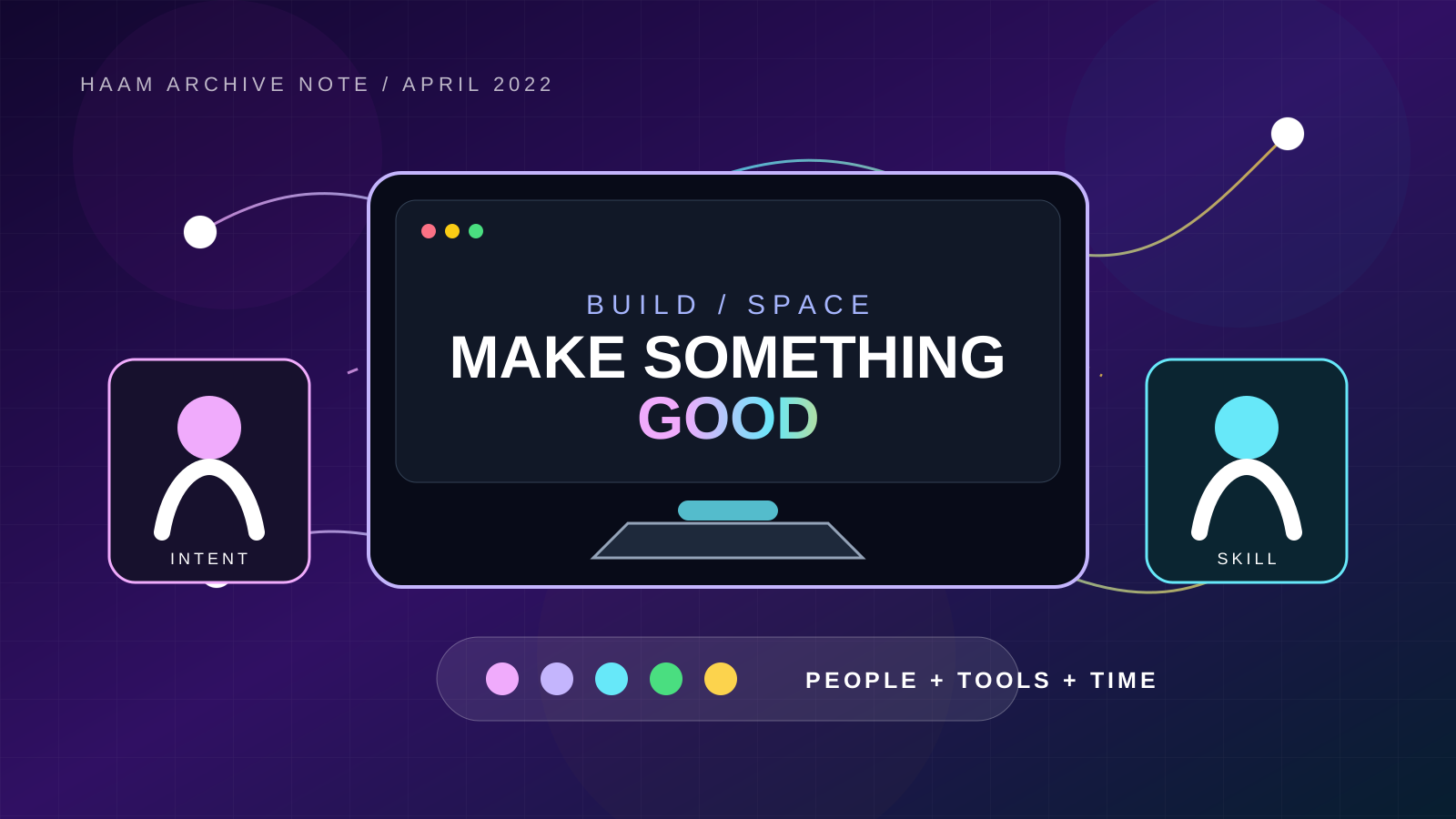
Buildspace was not memorable because it taught people to code. It was memorable because it made beginning feel legitimate.
Its surviving homepage describes Buildspace as a school for people who wanted to work on their own ideas. That distinction is the whole model. The institution did not own the assignment. The participant arrived with an intention, however incomplete, and the school organised energy around it.
This is close to what HAAM could become: not another blank AI prompt and not a marketplace where a client purchases isolated labour, but a place where an intention gathers tools, skills, people, feedback, and proof.
What my archive actually shows
Participation leaves fragments, not always a neat biography.
The earliest surviving evidence includes two Buildspace Discord notifications and a public Buildspace OS repository. The later public trail includes the TikTok I made for Green Filter and the project's dedicated Instagram account. Together, these artifacts show participation, continued making, and a project moving into public view. They do not establish that I completed a particular season or won a demo day, so I am not claiming those things.
April 1, 2022
Buildspace x Terra
A Discord notification in my email archive announced a weekend programme about stablecoins, Rust, and shipping a Terra dapp. It captures the version of Buildspace I encountered: fast, crypto-native, practical, and organised around making a working thing.
April 6, 2022
One million project-page views
A second notification, posted by Farza, said the Buildspace projects route had passed one million views and introduced a redesigned project directory. The achievement being celebrated was not course completion. It was people looking at things other people had made.
Public GitHub artifact
A copy of Buildspace OS
A Buildspace OS repository still sits in my GitHub account. Its setup promised that no coding knowledge was required and turned the browser new-tab page into a Buildspace layer. It is a small artifact, but it shows how the community tried to occupy everyday attention, not only a lesson portal.
The project I carried forward
Green Filter became a public identity, not only an unfinished idea.
The most useful evidence of a maker programme is rarely a certificate. It is the thing that continued after the programme ended. Green Filter gained a name, a public explanation, and channels where the project could be seen and followed.
These links matter because they show the transition Buildspace was trying to produce: from private intention to visible artifact. The project was no longer only something I was thinking about. It was something I had to present clearly enough for other people to encounter.
TikTok
The Green Filter project video
I made this short public video for the project. It is evidence of the idea moving beyond an internal build and becoming something I was willing to explain, frame, and release in public.
Watch the TikTok ↗The Green Filter project account
The dedicated Green Filter account gave the project an identity that could accumulate experiments, explanations, and an audience over time. The project became a public presence, not only a private prototype.
Open Green Filter on Instagram ↗The design of the feeling
Four things Buildspace got very right
01
Your idea was the curriculum
Buildspace did not begin by asking which subject you wanted to study. It asked what you wanted to make. Skills became resources acquired in service of intent rather than prerequisites that delayed beginning.
02
Momentum mattered more than mastery
The culture rewarded showing progress, shipping a rough version, and returning the next week. That created a productive social pressure: not the pressure to appear brilliant, but the pressure to keep the idea alive.
03
Community made ambition feel normal
A strange or unfinished idea feels less embarrassing when hundreds of other people are also trying things. The community supplied permission, witnesses, feedback, collaborators, and the sense that making could be an ordinary part of life.
04
It designed rituals, not only software
Projects, houses, live streams, seasons, demo days, and a physical San Francisco campus turned an online platform into a lived culture. The interface mattered, but the recurring rituals produced belonging and memory.
The ending matters too
Buildspace closed while it still had momentum.
In his final letter, founder Farza Majeed wrote that the company had run its largest season, launched an AI product to 100,000 users, built a physical campus, and reached millions through its content. The reason for closing was not the familiar startup story of immediate financial failure. He felt the work was complete for him and could not find a new direction he believed in strongly enough.
That makes Buildspace more useful as a precedent, not less. A community can be culturally successful and still depend too heavily on one person's continuing fire. HAAM needs a structure in which intentions, methods, relationships, and contribution histories can outlive a season or founder.
What HAAM can carry forward
Keep the permission. Expand the machinery.
From cohorts to persistent workshops
Buildspace created intense seasons. HAAM could preserve that energy while giving every intention a permanent project home, with decisions, files, contributors, prototypes, and outcomes remaining legible over time.
From software to whatever
The same structure should work for a product, film, event, research project, neighbourhood intervention, physical object, or company. The common unit is not code. It is something a person intends to bring into existence.
From community encouragement to skill coordination
AI can help decompose an idea, identify missing capabilities, produce early drafts, and route questions. People can join with judgment, craft, access, money, equipment, lived experience, or specialised skill.
From attention to contribution history
A HAAM identity should show what someone helped make, where they were useful, and how the work changed because they joined. Reputation would come from contribution rather than follower count.
HAAM should be where whatever you want to make finds the intelligence, people, skills, and tools required to become real.
Sources and archive
What this note is based on
- Private Gmail archive: Buildspace Discord notifications dated April 1 and April 6, 2022.
- Buildspace: the surviving homepage
- Farza Majeed: final Buildspace letter
- Buildspace OS source repository
- Kris Haamer: surviving Buildspace OS copy
- Kris Haamer: Green Filter project video on TikTok
- Green Filter project account on Instagram