


July 6, 2026 · 18 min read
Make Anything
A market overview of the platforms turning the internet into a universal workshop, and the missing layer between making an artifact and delivering a complete real-world outcome.
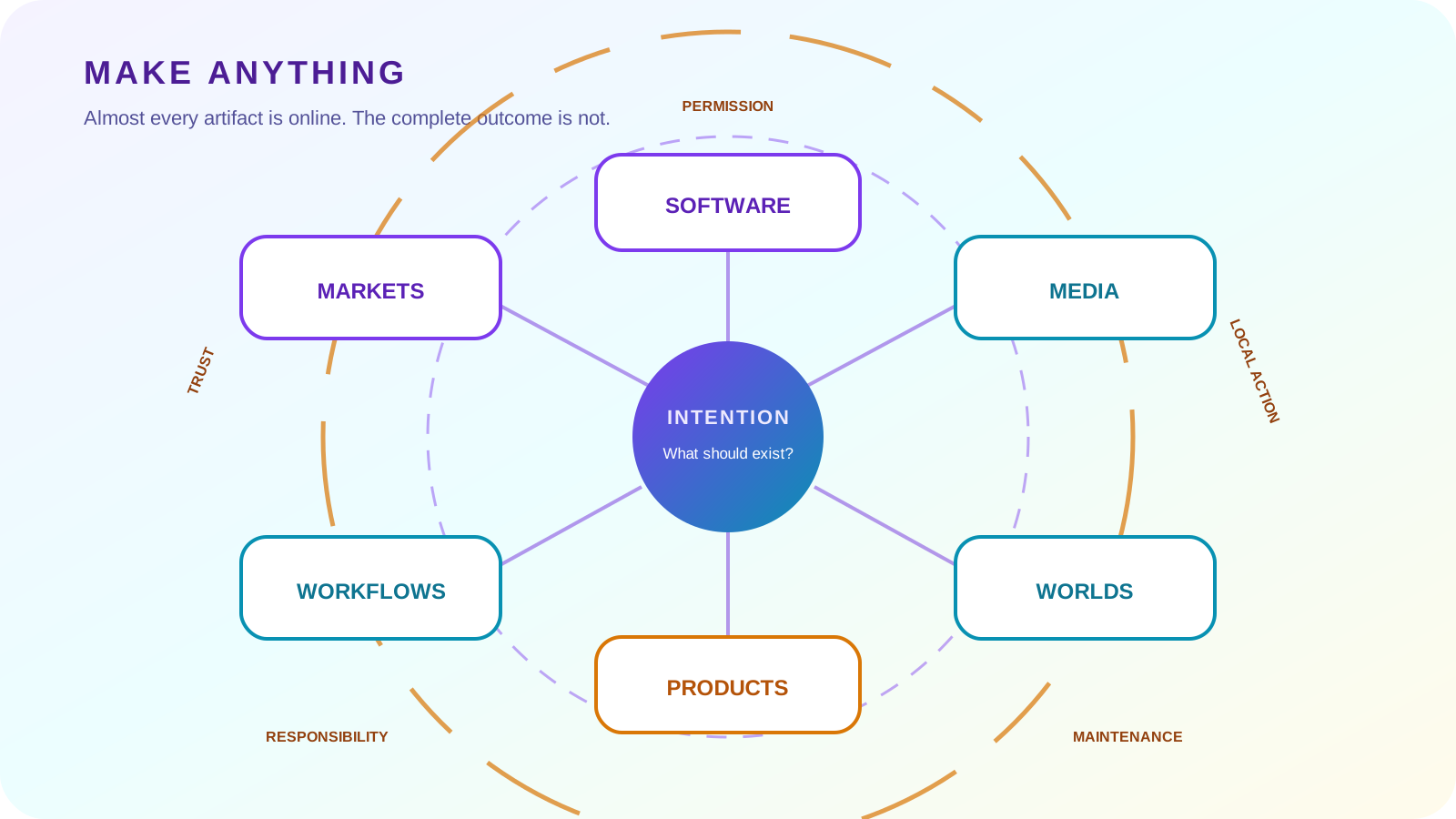
The internet is becoming a universal workshop
For most of the internet's history, being online meant consuming something. People opened pages, watched videos, listened to music, bought products, and communicated with one another. Creation happened too, but the serious tools usually belonged to specialists who already understood the medium. The web distributed finished work more easily than it distributed the ability to produce it.
That balance has changed. A person can now describe an application and receive working software, sketch a product and send its geometry to a factory, generate a song from a feeling, create a film without a camera crew, build a game world, open a store, raise money, and automate much of the operation that follows. Some of these outputs are rough, some are surprisingly complete, and many still need expert supervision. Even so, the direction is clear: production capacity is moving closer to anyone who can express an intention.
This does not mean one service can literally make anything. It means the online creation market has expanded until almost every medium has its own accessible workshop. The useful question is no longer whether people can make things online. It is how far the current platforms can carry an idea before the maker has to become the integrator of many disconnected systems.
Software has become something you can describe
The most visible shift is happening in software. Replit, Lovable, Bolt, v0, Base44, Bubble, Webflow, Framer, Glide, and Softr approach the problem from different directions, but all reduce the distance between an idea and a functioning digital product. GitHub remains the collaboration and version-control layer underneath much of the professional software economy, while newer prompt-to-app products increasingly hide the initial complexity of files, frameworks, databases, and deployment.
Replit presents its Agent as a way to turn natural-language requests into apps and websites, with deployment included. Lovable and Bolt similarly move from a conversation to an editable full-stack project. v0 starts from interface generation but has expanded toward complete applications. Bubble, Glide, and Softr use visual structures and existing data sources, while Webflow and Framer turn designed pages into published websites. The interfaces differ, but the market promise is converging: users should be able to begin with what they want the software to do rather than with the syntax required to build it.
The remaining limits are less visible than the generated interface. Prompt-based development can produce insecure permissions, fragile integrations, inconsistent data models, or a product that works only along the happy path. A person who does not understand the system may also be unable to judge when it is unsafe. These platforms make a software artifact easier to create, but they do not guarantee that it is maintainable, compliant, necessary, or trustworthy.
Creative software is collapsing into connected suites
Visual creation used to be divided into separate professional applications. Canva, Figma, Adobe Creative Cloud, Adobe Express, Penpot, Spline, FigJam, and Miro now show a different trajectory. The canvas is becoming a connected workspace where a team can move from research and planning to interface design, presentation, animation, video, publishing, and collaboration without treating every format as an isolated file.
Canva's Visual Suite spans documents, whiteboards, presentations, social media, video, print, websites, email, and spreadsheets. Figma connects product interface design with prototypes, collaborative planning, and increasingly direct publishing. Adobe remains deeper in specialist image, layout, motion, and film production. Penpot provides an open-source interface-design alternative, while Spline brings interactive 3D work into a browser-native environment. Miro and FigJam make the early stages of making visible by turning conversations, diagrams, and workshop outputs into shared spatial documents.
These platforms are becoming broad enough to make almost any representation of an idea. They can show how a service should work, how a brand should feel, how a product might look, or how a campaign could unfold. Their boundary is the difference between representation and operation. A beautiful service blueprint is not a staffed service. A brand system is not a reputation. A polished prototype is not an organization capable of keeping its promise.
Worlds, films, and songs can be made inside platforms
Roblox Studio, Unity, Unreal Engine, Unreal Editor for Fortnite, Godot, GameMaker, Construct, GDevelop, PlayCanvas, Minecraft, Rec Room, and Dreams have turned world-building into a widely available practice. A creator can make environments, characters, economies, social spaces, simulations, and interactive stories, then place them in front of an audience without first constructing a separate distribution system.
Roblox is especially complete because the authoring environment, identity system, audience, payments, and social layer exist inside the same platform. Unity and Unreal reach further into film, architecture, industrial visualization, extended reality, and simulation. Godot offers an open-source route, while browser-oriented tools such as Construct, GDevelop, and PlayCanvas reduce setup friction. Minecraft, Rec Room, and Dreams blur the line between playing and authoring by making creation part of the experience itself.
A similar convergence is happening in linear media. Runway, CapCut, Descript, DaVinci Resolve, Premiere Pro, After Effects, Final Cut Pro, Vyond, Blender, and Unreal Engine cover overlapping parts of video generation, editing, animation, sound, virtual production, and effects. Suno and Udio can create complete songs from prompts, while BandLab, Soundtrap, GarageBand, Ableton Live, Logic Pro, FL Studio, Audiotool, and Splice support recording, production, collaboration, and distribution workflows.
It is now possible to make an image, song, scene, short film, game, or virtual world with dramatically less equipment and labor. What remains difficult is sustained coherence. Platforms can generate individual shots, tracks, levels, and characters much more easily than they can produce a durable artistic identity, a long-form work that remains meaningful, or an audience relationship that survives beyond the novelty of the output.
Digital design now reaches the factory floor
The boundary between online and physical making is also thinner than it first appears. Blender, Autodesk Fusion, Tinkercad, Onshape, Shapr3D, SketchUp, Rhino, FreeCAD, SolidWorks, Gravity Sketch, and Nomad Sculpt allow people to model products, furniture, buildings, machines, sculptures, and components. Many of these tools include simulation, collaboration, manufacturing preparation, or direct connections to production services.
Electronics platforms extend that pipeline. Arduino, Raspberry Pi, Adafruit, SparkFun, Wokwi, KiCad, EasyEDA, Seeed Studio, Particle, and micro:bit make it possible to design circuits, write firmware, simulate embedded systems, order boards, and connect sensors or actuators to the physical world. Instructables, Hackaday.io, Make: Projects, Printables, Thingiverse, and MakerWorld distribute the knowledge and files needed to reproduce projects. Fab Labs and other makerspaces provide local access to machines that remain too expensive or specialized for most homes.
Xometry, Protolabs, PCBWay, and similar manufacturing networks close another part of the gap. A designer can upload a CAD file or circuit-board design, select materials and processes, receive a quote, and order a physical part. CNC machining, sheet-metal fabrication, injection moulding, casting, printed circuit boards, and additive manufacturing are increasingly accessible through interfaces that resemble online commerce.
The important distinction is that these services usually manufacture a specified component. They do not necessarily own the complete product. A device may still need sourcing, assembly, testing, certification, packaging, logistics, installation, software support, repair, and disposal. The model can be finished while the object is not. The object can be finished while the product system around it is still missing.
Work itself has become a material
Zapier, Make, n8n, Gumloop, Lindy, Relay, Dify, Flowise, Langflow, Microsoft Copilot Studio, and Google's agent-building products let people make something less visible than a website or a manufactured part. They let people make a process. Data can move between systems, approvals can be requested, documents can be generated, customers can be answered, and AI agents can take actions through external tools.
The newer platforms combine explicit workflow logic with language models, tool access, human checkpoints, logs, and evaluations. n8n, for example, describes systems in which integrations, agents, code, and human approvals operate together. This changes the role of automation from a fixed sequence of triggers and actions into a more adaptive operational layer.
Yet automation platforms inherit the quality of the organization around them. They can automate a process without knowing whether the process is fair, useful, legal, or strategically sensible. They can move data between teams that have never agreed on its meaning. They can speed up a decision whose owner remains unclear. Workflows can now be made online, but organizational judgment and accountability cannot be generated as another node in the diagram.
Launching and selling have become infrastructure
Kickstarter, Etsy, Shopify, Gumroad, Patreon, Product Hunt, itch.io, Steam, Substack, YouTube, and GitHub address what happens after creation. They help makers find money, publish work, sell products, form memberships, reach audiences, and distribute software or media. Shopify has grown from a store builder into a broad commerce operating system spanning checkout, payments, inventory, shipping, point of sale, marketing, analytics, international selling, and agentic commerce. Kickstarter provides a structured test of whether enough people will finance an idea before full production.
This layer matters because creation without distribution often remains invisible. A game needs players, a publication needs readers, a product needs buyers, and an ongoing practice needs revenue. These platforms provide technical access to markets that once required publishers, retailers, broadcasters, record labels, or specialized payment and logistics infrastructure.
They still cannot guarantee demand. A store can be live tomorrow while the reason to visit it remains absent. A crowdfunding campaign can be perfectly produced and receive no pledges. A video can be distributed globally and never become culturally relevant. The internet has reduced the cost of supply much faster than it has reduced the difficulty of earning attention, trust, and repeated preference.
The market is strongest when the result is an artifact
Across all of these categories, a pattern appears. The internet is extremely good at helping people make artifacts. An artifact may be a file, a database, a model, a song, an application, a schematic, a workflow, a campaign, a manufactured part, or a published virtual environment. It has a boundary. It can be transmitted, copied, versioned, evaluated, purchased, or processed by another system.
This is why the creation market has advanced so quickly. Computers work well with representations, and networks work well with moving representations between specialized services. A product can begin as research in Miro, become an interface in Figma, turn into software in Replit, connect to operations through n8n, launch on Product Hunt, and take payments through Shopify. A physical component can begin in Fusion, be reviewed through a shared model, and be ordered from Xometry or PCBWay.
The maker is still doing the stitching. Each service knows its own artifact, account, transaction, or workflow. The broader intention travels informally through documents, messages, meetings, and the maker's memory. When the project crosses a boundary, context is lost and responsibility resets.
A few platforms are beginning to cross the boundaries
The market is not standing still. GoDaddy Airo bundles a domain, website, logo, and marketing materials around the act of starting a small business. Shopify connects more of the commercial lifecycle than a conventional store builder. Roblox joins creation, distribution, identity, community, and monetization inside one world. Manufacturing networks integrate quoting, supplier matching, production, and delivery. Agent platforms increasingly operate across many external applications rather than remaining inside a single chat.
More experimental services are trying to connect digital agents to physical labor. Quest coordinates broad categories of local human tasks, while RentAHuman and similar marketplaces let software agents commission people to act in the physical world. These projects are early and raise serious questions about safety, verification, labor conditions, and who is legally responsible for an agent's request. They are still significant because they expose the exact boundary the rest of the market has not crossed: software can plan and transact, but it still needs bodies, locations, institutions, and trust to change the physical world.
These are partial integrations, not universal making systems. They work within a defined domain, platform economy, or transaction type. The bakery, medical device, public exhibition, housing project, festival, school, or neighborhood intervention still requires someone to understand the whole project and connect the parts.
An outcome is not the same as an artifact
An outcome is a change that continues to exist in reality. A profitable café is not its logo, menu, booking system, or interior rendering. A safe medical device is not its prototype. A functioning community is not its Discord server. A well-maintained building is not its architectural model. A successful event is not its promotional campaign.
Outcomes involve time, human behavior, money, local conditions, negotiation, authority, risk, and maintenance. They are open systems. People can refuse, weather can change, suppliers can fail, laws can differ, and a solution can produce consequences outside the frame originally used to design it. No file contains the complete state of the world in which it will operate.
This is the main frontier left by the current maker economy. The platforms can create nearly every ingredient, but they rarely accept responsibility for whether the ingredients become a coherent and durable result.
Complete physical execution is still unavailable
A house can be designed online, components can be quoted online, contractors can be discovered online, and progress can be documented online. The house itself must still be built on a particular site. Materials need to arrive, workers need to perform physical tasks, unexpected conditions need to be resolved, and inspections need to happen. The same is true of a restaurant, laboratory, garden, factory, exhibition, or piece of public infrastructure.
The physical world is not simply the final step of a digital workflow. It is full of unique conditions that resist standardization. A measurement is wrong, a wall contains an unknown pipe, a delivery does not fit through the door, a subcontractor is unavailable, or the local authority interprets a rule differently. Online services can coordinate parts of this work, but no general platform can currently guarantee end-to-end execution across locations and industries.
Local execution is also where trust becomes concrete. Someone must be allowed onto the site, handle valuable materials, make irreversible changes, and be accountable if something is damaged. Matching supply and demand is not enough. The system needs verification, insurance, dispute resolution, professional competence, and clear ownership of the result.
Permission and certification remain institutional
Many things cannot become real merely because they can be designed and paid for. Construction products in the European Union operate within harmonized performance and marketing rules. Medical-device manufacturers in the United States must work within the FDA's Quality Management System Regulation, which became effective in its updated form on February 2, 2026. Conformity assessment can involve testing, inspection, validation, certification, and accreditation. Biological laboratory work requires physical containment, trained people, risk assessment, and biosafety practices.
A platform can help prepare evidence and applications, but it cannot simply grant a building permit, approve a medicine, recognize a qualification, issue a visa, transfer public land, or authorize a regulated business. Institutions do more than process information. They confer legitimacy and accept a role in the chain of responsibility.
This makes regulation a fundamentally different kind of dependency from an API integration. It cannot always be automated, bypassed, or standardized globally. The authority is intentionally local, sector-specific, and accountable to law. Any future intention-to-outcome platform would need to work with institutions rather than pretending they are friction to be removed.
Trust, judgment, and demand are still human bottlenecks
Online marketplaces can locate specialists, and AI can compare portfolios, write briefs, propose budgets, and schedule work. None of that automatically creates a trusted team. Trust accumulates through evidence that people keep promises, surface problems early, admit mistakes, protect one another's interests, and remain present when the project becomes difficult. A team is not merely a collection of matched capabilities.
Judgment is another unresolved layer. Generative platforms can produce more options than a person can reasonably inspect, but abundance does not decide what deserves to exist. Someone must determine whether an idea is appropriate, ethical, useful, distinctive, and worth its material and social cost. As making becomes cheaper, choosing well becomes a larger part of the work.
Demand remains equally stubborn. Platforms can generate products, stores, campaigns, videos, and sales copy, but they cannot reliably create desire. Demand depends on timing, culture, purchasing power, competition, relationships, reputation, and whether the proposed thing solves a problem people recognize. It is easier than ever to make something nobody needs.
Responsibility is fragmented across the stack
Current platforms divide a project into transactions. A design tool is responsible for the file, a manufacturer for the specified component, a marketplace for the introduction, a payment provider for the transfer, and an automation service for executing configured steps. Each can satisfy its local contract while the overall result still fails.
This becomes especially difficult when AI agents act across systems. An agent may choose a supplier, send a message, modify a database, hire a person, or initiate a purchase. The action may be technically traceable while its authority remains ambiguous. Who had the right to make the decision, who checked the assumptions, and who compensates the affected person when the result is wrong?
There is no broadly adopted accountability layer that follows an open-ended project from intention through delivery and long-term operation. Insurance, escrow, professional licensing, warranties, audit logs, contracts, and human approvals each solve parts of the problem. They do not yet form a universal system of responsibility.
The internet is optimized for beginnings, not stewardship
Most creation platforms celebrate the moment something appears. The app is deployed, the campaign launches, the product ships, the store opens, or the video is published. The interface is built around starting and releasing because these moments are visible, measurable, and emotionally satisfying.
Reality is held together by maintenance. Software needs security updates and migration work. Hardware needs replacement parts, documentation, recalls, and repair. Buildings need cleaning and inspection. Communities need moderation and governance. Automated workflows fail when an API changes. A business can survive its launch and still disappear because no system owns the repetitive care that follows.
Maintenance is difficult to package because its value is often the absence of failure. It extends across years, involves changing people and suppliers, and rarely fits a single transaction. The current maker economy has strong launch infrastructure and weak stewardship infrastructure.
What still is not available
As far as this market scan could identify, there is no widely adopted platform where a person can state an open-ended real-world intention and receive a complete, accountable, maintained outcome. A user cannot simply ask to open a neighborhood bakery, create a certified assistive device, organize a public exhibition, build a small house, restore a wetland, or establish a local school and have one system reliably determine, coordinate, and own everything required.
The missing capability is not another generator. It is an intention-to-outcome layer that can understand an ambiguous objective, discover what should actually be made, identify the necessary disciplines, preserve context across tools, coordinate digital and physical work, navigate local permission, verify the result, assign responsibility, and remain involved after launch.
Parts of this future exist separately. General AI systems can plan. Creative platforms can produce media. App builders can create software. Agent platforms can act across digital services. Marketplaces can find people. Manufacturing networks can make parts. Commerce platforms can sell products. Governments and professional bodies can authorize regulated activity. Maintenance providers can keep systems running. The gap is the connective institution that combines them without forcing the maker to become the permanent project manager, systems integrator, risk owner, and source of last resort.
The internet can now help make almost any artifact. It can even coordinate many transactions around that artifact. What it still cannot reliably make is the whole outcome, in a particular place, with legitimate permission, trusted execution, clear accountability, proven demand, and care that continues after the launch. That is the largest remaining gap in the online maker market.