HAAM product edition · The small daily things
Consistency
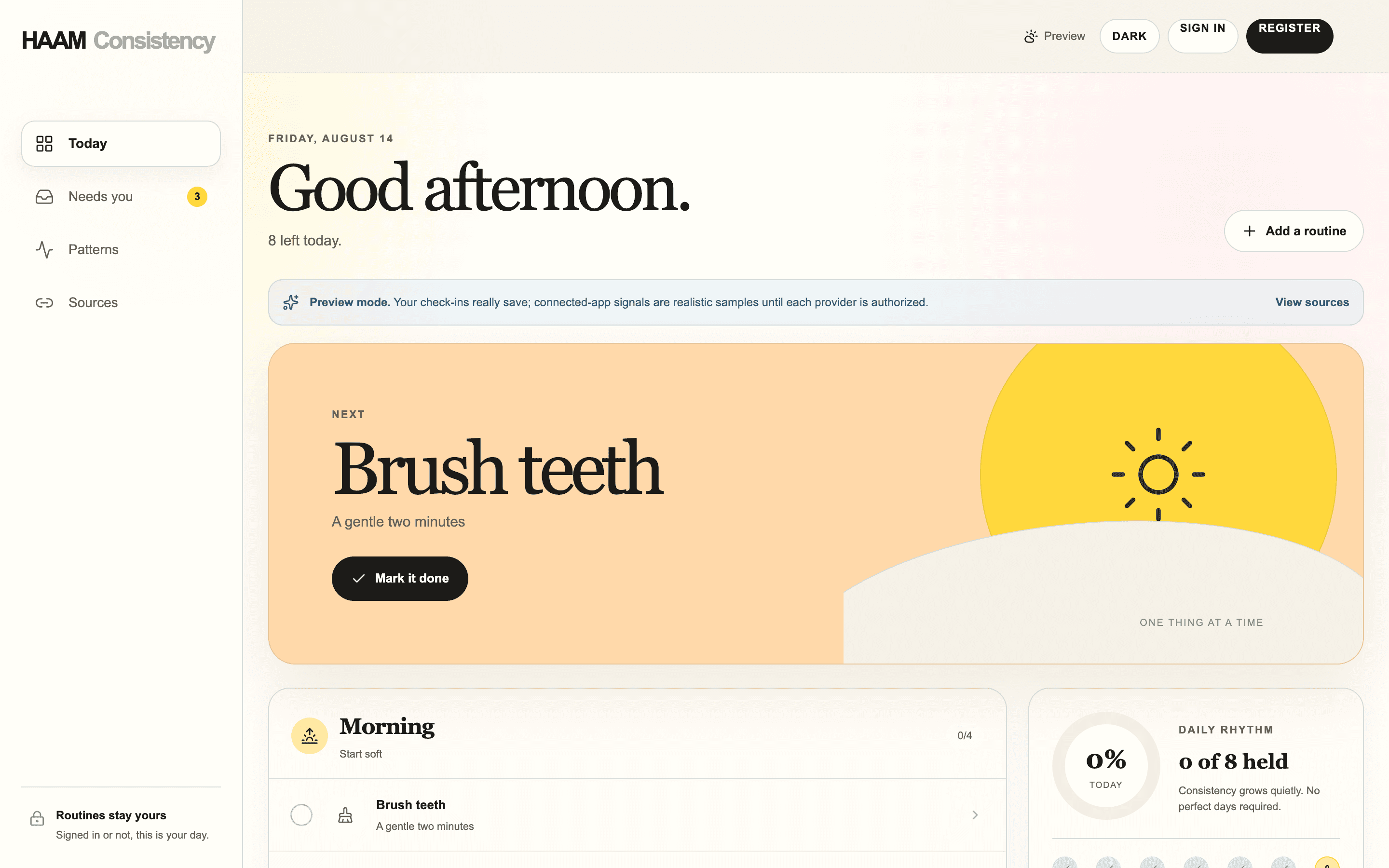
Consistency keeps the small daily things — especially morning and evening brush and floss — on a today list that waits for a tap. The iPhone app and the web companion share a catalog and a confirmation rule. They do not share a database.
Target interaction specification
Consistency
Did this small routine really happen today?
Consistency may use health, calendar, device, or time signals to suggest that a routine is relevant, but only explicit human confirmation can mark it complete. Every completion must be reversible, and the product must not manufacture pressure through fake certainty or punitive streak mechanics.
Case-study thesis
What the finished product should prove.
This is the behavior to build toward. The implementation receipts below remain the record of what exists today.
The interaction is the boundary between inference and memory. The product can help someone remember, but it cannot quietly rewrite what happened.
State model
The interface has to make these states real.
If two states would look identical to the person, the implementation is not finished.
Upcoming
The routine belongs to today but is not yet asking for attention.
Suggested
A contextual signal makes the routine relevant, without marking it complete.
Due
The routine is ready for an explicit yes, skip, or later decision.
Confirmed
A person marks the routine complete and the source of confirmation is recorded.
Undone
A mistaken confirmation is reversed without penalty or hidden history.
Skipped
The person intentionally decides not to do the routine today, distinct from forgetting.
Day closed
The previous day becomes history at the correct local boundary without silently carrying incomplete state forward.
Independent surface
Web and iPhone show their own store honestly until real sync exists.
Edge cases
The boring failures are part of the product.
- A health signal arrives after the person already confirmed the routine
- The same completion is tapped twice
- The person crosses time zones near the day boundary
- The web and iPhone disagree because they are not synced
- A suggested routine expires without action
- The user wants to distinguish skipped from forgotten
- A reset or export happens mid-day
Definition of done
The future case study needs these receipts.
- No external signal can move a routine directly into Confirmed
- Every confirmed routine has a one-step undo path
- Skip, forgotten, suggested, and confirmed remain visually and semantically distinct
- A timezone change does not duplicate or erase the wrong day
- Until synchronization is real, both surfaces explicitly disclose that they are independent stores
surfaces
2SwiftUI/SwiftData on iPhone, and a separate web companion. Same brush and floss catalog.
confirmation
TapCompletions need a tap or an explicit confirmation. Brushing is never auto-verified from Health.
export
v1formatVersion 1, covered by tests. Reset clears SwiftData, App Group, Keychain, and notifications in source.
public host
Previewconsistency.haam.co uses the in-browser session fallback. No D1 on that host.
The job
Keep the small care without pretending the phone already knows.
Morning and evening brush and floss are easy to mark done if Health or a busy calendar is allowed to speak for you. I wanted a today list that still waits for a person.
The day
See today’s list. Confirm what happened. Keep the surfaces honest.
01
Open today
The default catalog is morning and evening brush and floss. Parity tests keep the web list aligned with the iPhone list.
02
Let a signal suggest
Health and Calendar may add context. They do not tick the row. Completions require a tap or an explicit confirmation.
03
Undo if you missed
A completion can be taken back. The in-memory SwiftData tests cover that path.
04
Export or reset
Export writes formatVersion 1. Reset is a full local clear on device. The web host does not offer an in-app reset in this pass.
Design decisions
Decisions.
Confirmation
The person remains the source of whether it happened.
A wearable can notice movement. It cannot floss for you. I kept brushing and flossing off the auto-complete path even when Health or Calendar is connected.
Independence
Two companions, one rule, two stores.
Sync would have been the attractive lie. CloudKit is configured for signed devices and is not two-device verified. There is no CloudKit↔D1 bridge. Each surface owns its own check-ins.
System surfaces
Widgets and Shortcuts share a snapshot, when a signed device exists.
App Group snapshot, widgets, Shortcuts, and Live Activities are in source. Simulator success is not a physical iPhone log. The public web host is a preview of the companion, not the iPhone.
The working stack
Built with.
iPhone
SwiftUI + SwiftData
Today, confirm, sources, privacy, export, reset. iOS 26 / Xcode 27 locally.
Web
Companion UI
Same catalog. Public host uses in-browser session fallback; D1 is optional and not on consistency.haam.co.
Tests
Catalog and undo
Web npm test in CI. Swift tests for catalog, dayKey, export version, completion undo.
Host
consistency.haam.co
Vercel Next.js of the web companion. iOS remains a local/TestFlight prototype.
In evidence
Evidence.
01A today list that waits for a tap
02Matching brush and floss catalogs on iPhone and web
03Export formatVersion 1 in tests
04A public web preview that does not pretend to be the signed iPhone
Where it stops
The preview host is the web companion.
HealthKit, Calendar, notifications, widgets, Shortcuts, Live Activities, and CloudKit are not recorded as passed on a physical iPhone in the evidence file. Two-device iCloud is not verified.
Do not say it syncs across iPhone and web. Do not claim a public release or habit outcomes.
HAAM’s role
I kept the confirmation in the person’s hands.
Human-in-the-loop rule, two-surface independence, default catalog, SwiftUI/SwiftData tree, web companion, tests, and privacy docs. Direct work, 2026.
Help improve this website?
Optional analytics. Google Analytics and Clarity load only if allowed; form, email, and chat content are excluded.