The water was already boiling and curtain call was close. People needed tonight's show details before they even reached the door.
Intent
Bring audiences closer to theatre by making performances easier to discover, understand, and attend.
Why
The change for visitors was practical and immediate: less decoding, faster orientation, fewer dead ends before action. The change for the theatre team was operational: updates became repeatable instead of stressful one-off interventions.
A current-state review of Viirus Theatre, separated into the experience decision and the product decision.
Interaction Design
Current assessment
Repertoire, dates, tickets, languages, search, read-aloud support, subtitles, directions, and contact details form one of the strongest service experiences in the portfolio. External ticketing can still interrupt continuity.
Next interaction-design decision
Keep the selected date and ticket action persistent while visitors read production details, and provide a clear return path from external ticketing.
Product Management
Product job
Help audiences discover and attend performances while giving theatre staff a sustainable repertoire-publishing system.
North-star metric
Paid seat occupancy, supported by repeat attendance and first-time audience conversion.
Next product-management decision
Connect website behaviour, ticket sales, production capacity, and audience history so underperforming dates can trigger targeted campaigns.
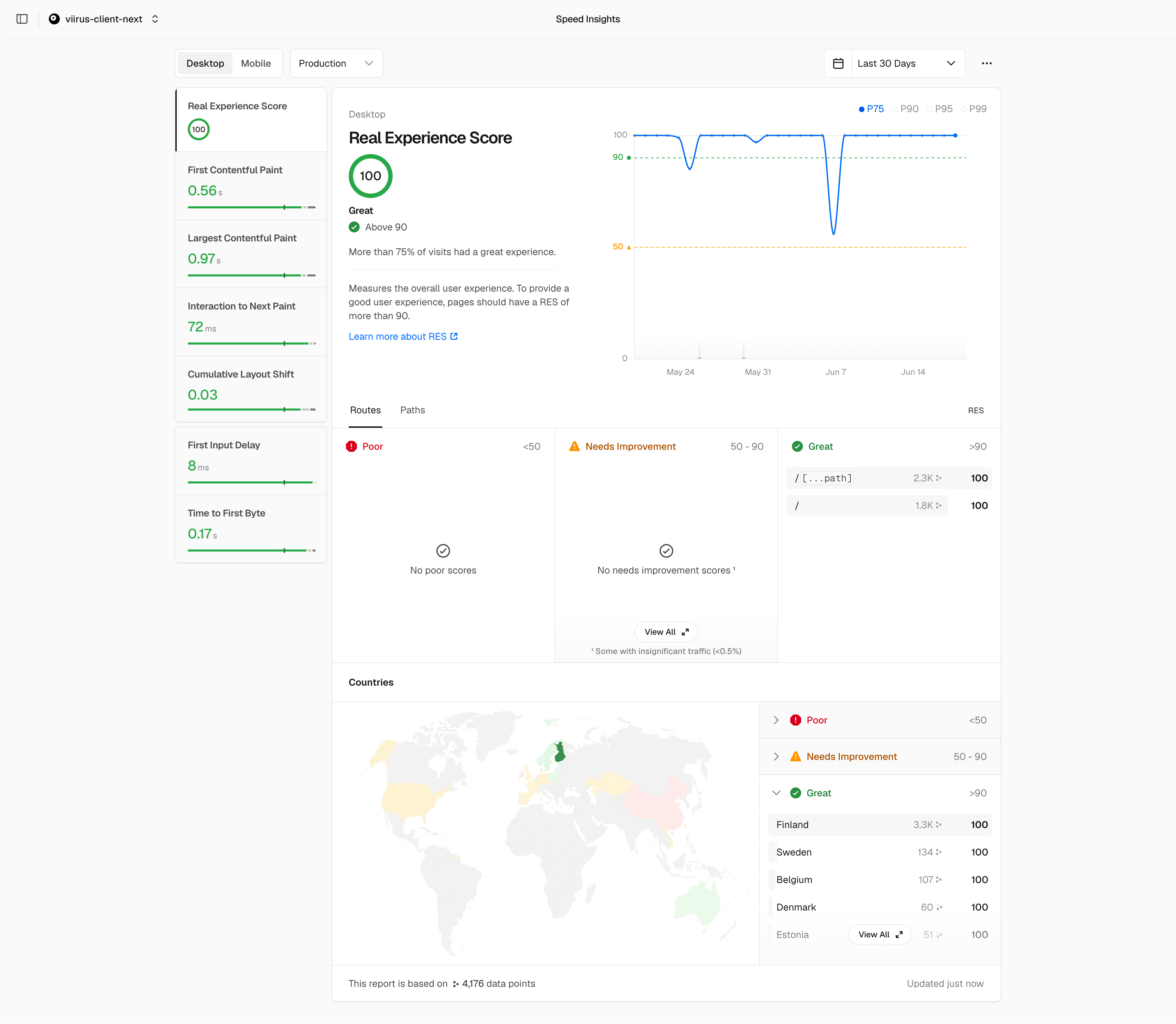
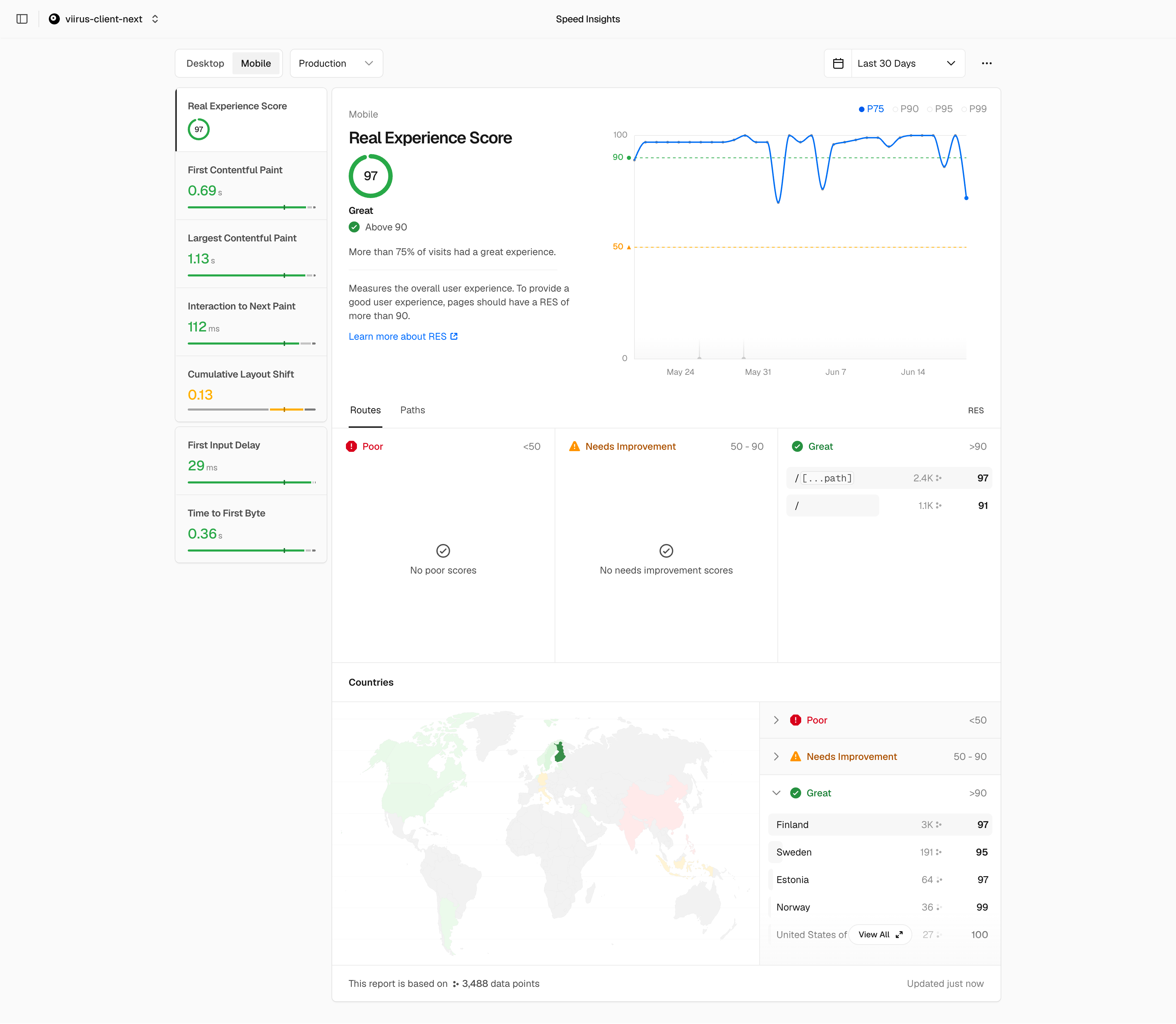
Theatre visitors often arrive on a phone, in transit, looking for a date, a show, or a ticket. Viirus was engineered so the visual identity does not slow that moment down. Over the 30 days captured on June 19, 2026, Vercel Speed Insights rated the real visitor experience at 100 on desktop and 97 on mobile.
Desktop
100
0.97s LCP · 72ms INP · 0.03 CLS
Mobile
97
1.13s LCP · 112ms INP · 29ms FID
01
Send less image data
Responsive image sizes and modern AVIF/WebP formats reduce transfer weight by up to 80%, while blur-up placeholders make visual pages feel immediate.
02
Prioritize what visitors see first
The main visual receives priority loading and the rest of the media waits until needed, protecting the Largest Contentful Paint on small screens and slower connections.
03
Keep the browser free
Less blocking JavaScript, restrained motion, and smarter loading leave the main thread available for navigation, search, calendar browsing, and ticket actions.
04
Cache the repeatable work
A Next.js front end and a deliberate caching strategy let pages arrive quickly without giving the theatre up-to-date editorial control through WordPress.
Desktop
Vercel Speed Insights · real-user field data
100 RES
Mobile
Vercel Speed Insights · real-user field data
97 RES
Field data varies with devices, networks, content, and traffic. These captures show the production site's previous 30 days as recorded on June 19, 2026.
Explore selected screens and layouts from this project:
Screenshots
Loading screenshots...
Project delivery notes
Project year: 2020
D) Story
Viirus Theatre needed a website that could carry artistic identity without slowing down the core ritual: decide, orient, and act. We redesigned the flow so each page behaves like theatre signage: clear entry, clear sequence, clear exit to ticketing. The result is a calmer audience journey under time pressure and a publishing structure the team can actually maintain.
B) Site + Situation
Site: Helsinki theatre context with mobile-heavy pre-show traffic and bilingual expectations.
Condition: Limited attention windows, frequent program changes, and mixed connection quality in transit.
Ritual: Check what is on tonight, confirm time, and move toward tickets in one pass.
Material: Speed, information hierarchy, and editorial sustainability under production deadlines.
C) Kitchen Notes
Dish: A theatre web experience that balances mood with immediate action.
Ingredients: Program archive, production visuals, editorial needs, and audience intent signals.
Heat: Launch cycles tied to performances and late schedule adjustments.
Taste test: Task-based walkthroughs (Tonight -> Production -> Ticket) plus event tracking for CTA progression.
E) Signals
Analytics signals: top paths clustered around program and ticket intent; instrumentation gaps closed.
Research signals: audience and staff feedback pointed to confusion in time/date scanning.
Performance signals: lightweight template targets introduced for hero and schedule pages.
Accessibility signals: keyboard path and heading order repaired on key performance pages.
F) Decisions
Rebuilt IA around "Tonight", "Calendar", and "Archive" to remove navigation hesitation.
Tightened schedule typography and spacing so date/time blocks scan in seconds.
Reduced decorative motion to keep interaction stable on mobile and low-power devices.
Elevated ticket actions in context rather than burying them at page end.
G) Score
Receipt: Ticket CTA progression can now be measured by page template.
Receipt: Scroll-depth and outbound tracking provide decision-ready evidence for iteration.
Receipt: Accessibility checks are now part of release rhythm, not post-launch cleanup.
If baseline conversion history is incomplete, continue instrumentation for one full season and compare by production type.
H + I) Artifacts and Leftovers
Artifact: IA map showing foyer-style wayfinding from arrival to action.
Artifact: Mobile-first wireframes for Tonight and Production pathways.
Artifact: Release checklist combining CWV, accessibility, and editorial readiness.
Leftover: Next iteration should test language-specific labels and compare completion by locale.