


HAAM Field Notes / Shanghai / March 2026
Design Shanghai 2026: The Building Was Part of the Exhibition
A professional visitor field note from Design Shanghai's return to the Shanghai Exhibition Centre, where architecture, craft, materials, global brands, and the city itself formed one design system.
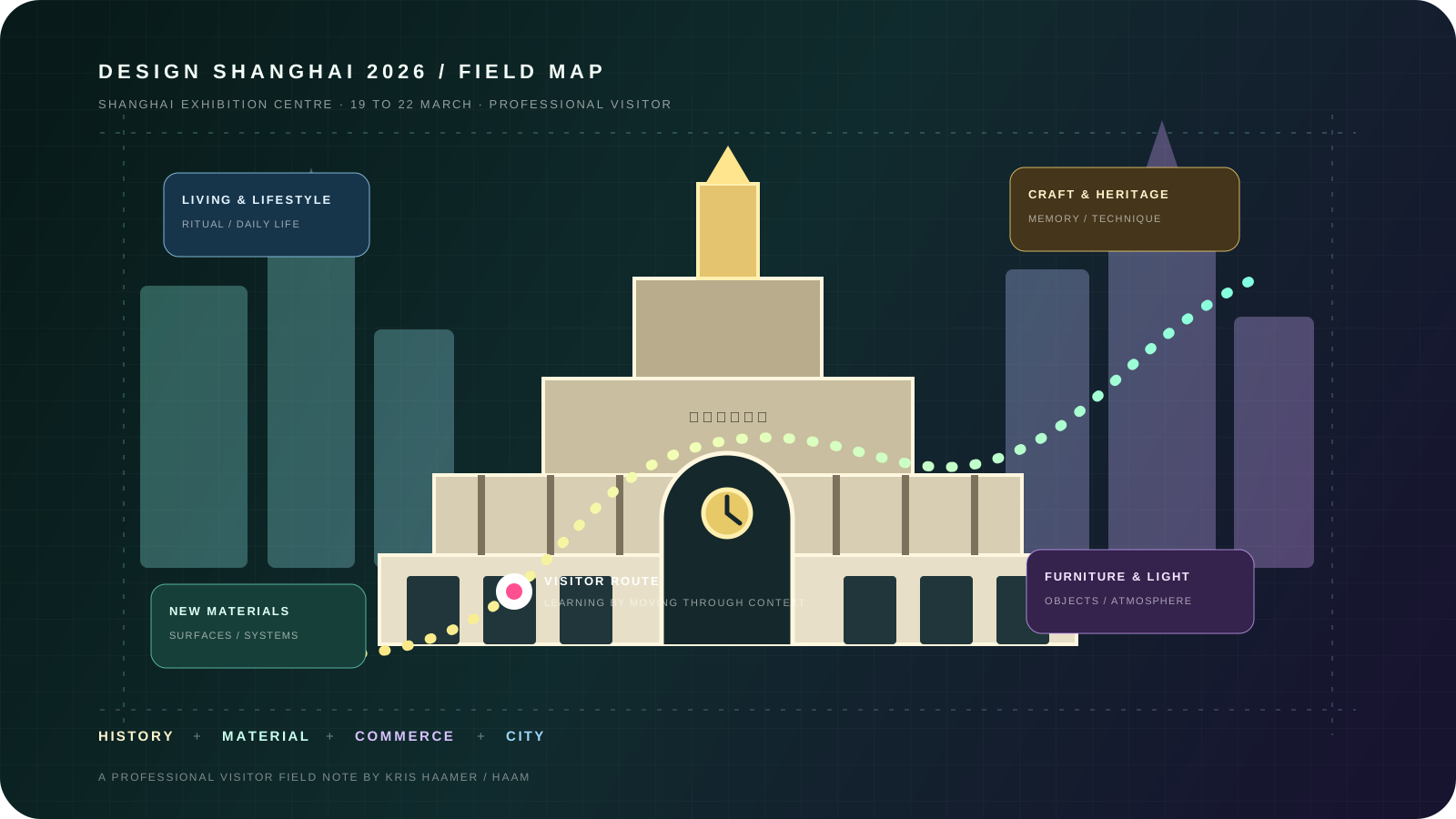
Table of contents
19 to 22 March
Four days at the Shanghai Exhibition Centre
43,000+
Visitors reported by the organiser
500+
Brands from more than 20 countries and regions
150+
Speakers across the talks programme
I entered as a professional visitor
On March 19, 2026, I attended the opening day of Design Shanghai at the Shanghai Exhibition Centre. My professional visitor registration had been approved under Haamer Ventures OÜ, placing the visit inside my ongoing work on HAAM rather than outside it as tourism.
I went to see products, materials, spaces, and people, but also to study the fair itself. A design exhibition of this scale is an interface. It has an entrance, information hierarchy, paths, landmarks, bottlenecks, pauses, competing signals, and a final question: what can a visitor still remember after the abundance has passed?
This note does not pretend to reconstruct every booth or conversation. It records the larger argument I carried away from the day: a serious design institution can make history and futurism occupy the same room without flattening either one.
The venue was an argument
The 2026 edition brought Design Shanghai back to the Shanghai Exhibition Centre, the venue where the fair began in 2014. The event described the return as a homecoming after six years. That decision changed the meaning of everything placed inside it.
The centre's colonnades, ceremonial entrances, tower, courtyards, heavy thresholds, and human-scale passages resisted the neutral exhibition-box logic. Furniture and lighting did not appear against an anonymous background. They appeared inside an inherited civic image, surrounded by the vertical glass city of contemporary Shanghai.
The building made time visible. A new material could sit beside architecture carrying another century's ambitions. A precise contemporary object could gain gravity from the room around it. The fair demonstrated that context does not weaken innovation. Context can make innovation legible.
Four sections contained several design economies
The organisers reported more than 43,000 visitors, over 500 brands from more than 20 countries and regions, and four principal sections: Furniture & Lighting, Kitchen, Bathroom & Systems Design, New Materials & Applications, and Living & Lifestyle.
Those categories made the fair navigable, but they did not describe one unified design industry. The halls brought together global product brands, Chinese studios, material suppliers, collectible work, commercial interiors, craft-led objects, experimental practices, and designers still establishing their public language.
Design Shanghai therefore behaved less like a catalogue and more like a temporary market ecology. Reputation, manufacturing capacity, cultural memory, finish, novelty, distribution, photography, and spatial presentation all operated at once. The object was only one part of the offer. The rest was the system that made the object credible.
Craft was treated as a living technology
The strongest curatorial signal came from the features surrounding the commercial halls. Made in JDZ connected contemporary practice to Jingdezhen's porcelain culture. Beyond Craft brought traditional techniques into present-day objects. Collectible Design & Art, Materials First, and TALENTS placed different forms of value beside one another: heritage, experimentation, scarcity, utility, and emerging authorship.
This matters because old craft is often presented in one of two weak ways. It becomes a museum relic, protected from change, or a decorative motif stripped from the knowledge that produced it. Design Shanghai showed another path. Technique could remain historically specific while entering new structures, markets, and visual languages.
That is close to the problem HAAM is trying to solve as a century-scale brand. Longevity cannot come from making new work look artificially old. It comes from developing continuity: materials, standards, stories, methods, archives, and recognizable judgement that can survive stylistic change.
The fair operated as an interface for attention
The talks programme involved more than 150 speakers, while the exhibition floor offered thousands of possible encounters. At that scale, participation depends on exclusion. Every route through the fair is also a decision about what will remain unseen.
This is an interaction design problem. Signage, hall boundaries, visual anchors, programme structure, queues, rest points, staff guidance, and the contrast between loud and quiet displays all shape what becomes available to thought. A visitor does not experience the event database. A visitor experiences one path through it.
The historic venue helped because it produced distinct rooms and thresholds. Movement felt segmented rather than endless. The architecture gave the programme a rhythm: enter, concentrate, cross, emerge, reorient, and continue.
Shanghai continued the exhibition outside the gate
The official Design in the City programme extended the fair through more than 100 design locations, more than 20 public events, and 15 studio open days. This made the central exhibition one node in a wider urban network of studios, showrooms, galleries, shops, hospitality spaces, and streets.
That extension matters. International fairs can create sealed professional bubbles in which a city becomes a hotel, venue, taxi, and airport. Design Shanghai proposed the opposite relationship. Shanghai was not only the location printed below the event name. The city was another exhibition medium.
For HAAM, this reinforces a broader principle: physical participation becomes more valuable when it creates relationships between the formal programme and the living place around it. The room concentrates attention. The city gives that attention context.
What HAAM carried away
Design Shanghai clarified what gravitas can look like without becoming conservative. The fair used an old institution to frame new work, but did not ask the new work to imitate the building. Contrast created dignity.
It also showed why curation matters more as abundance grows. Five hundred brands do not automatically become an institution. Sections, features, invited voices, spatial order, recurring rituals, and a point of view turn scale into meaning.
HAAM should work the same way. The website, archive, services, field notes, research, and future products should feel like rooms inside one institution. Each can carry its own visual and technical language while remaining connected by standards of care, accessibility, performance, evidence, and historical memory.
Participation should leave a record
Professional events are often reduced to a badge photograph and a sentence about networking. That kind of record disappears quickly because it says almost nothing about what changed.
The useful claim here is smaller and more durable. I went to Design Shanghai as a professional visitor. I observed how a major Asian design fair used architecture, curation, craft, commerce, and the city to construct institutional authority. I returned with a sharper idea of how HAAM can feel both old and unfinished, rooted and experimental, serious and alive.
The visit now belongs to the HAAM archive because participation becomes valuable when it can still inform the next decision.