


Field note · July 4, 2026 · 12 min read
YODEX, the Design City I Could Only Visit
As a master's student at NCKU, I could not exhibit at Taipei's YODEX. Walking through it several times instead taught me to see design education as a temporary city, a public ritual, and a living system.
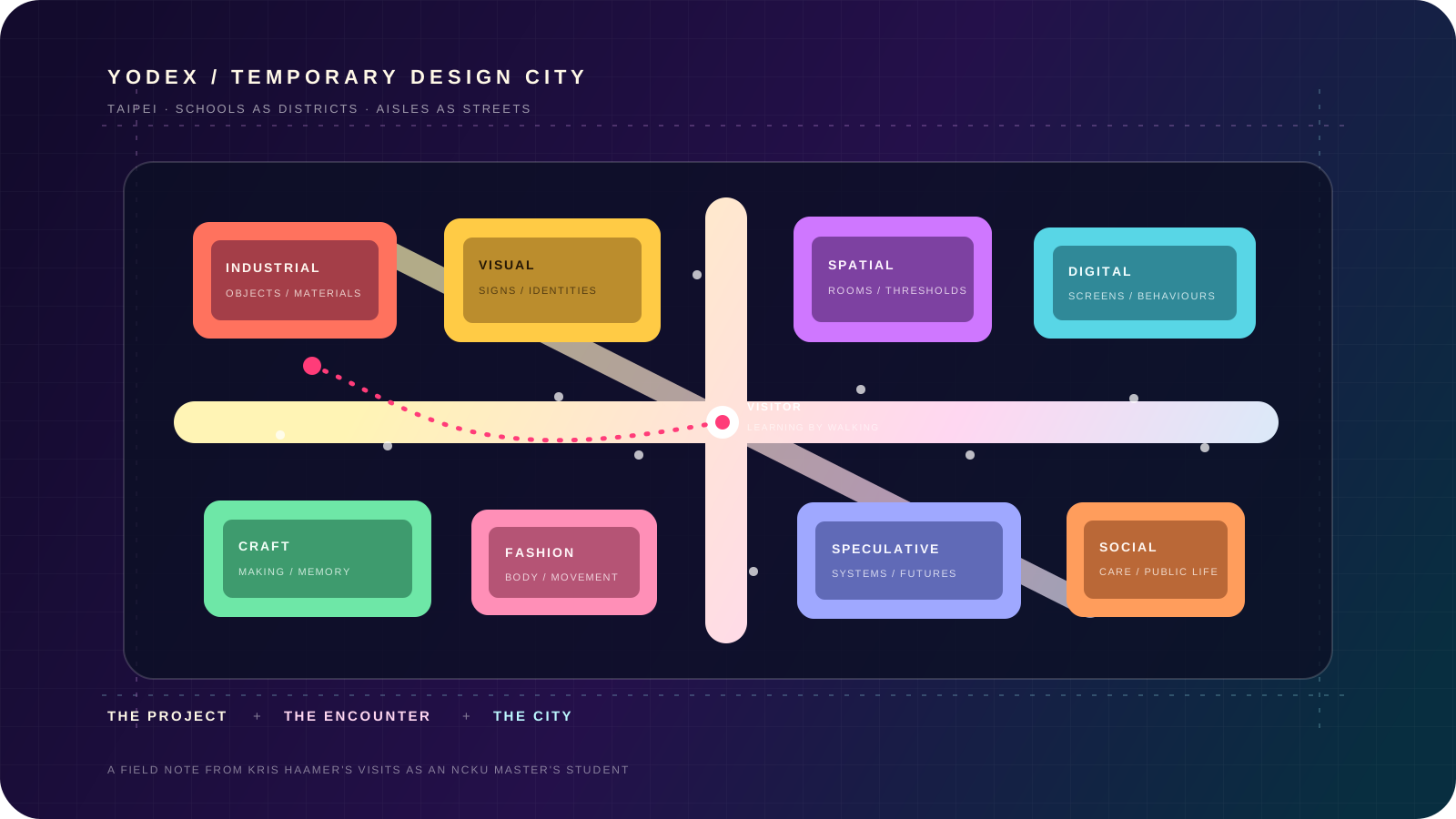
Table of contents
Every year, a design city appears in Taipei
Every year, Taiwan's design schools temporarily construct a city inside an exhibition hall. They bring walls, screens, lights, prototypes, fabrics, furniture, films, interfaces, speculative machines, and thousands of graduating students to Taipei. For several days, the hall becomes a compressed model of Taiwanese design education.
The official YODEX description says the exhibition has gathered graduating work under one roof since 1982 and attracts more than 80,000 visitors in a typical year. Fashion, industrial design, visual communication, and interior design sit beside one another, not as categories in a curriculum document but as physical territories that can be entered, crossed, compared, and remembered.
I visited YODEX several times while studying for my master's degree at National Cheng Kung University's Institute of Creative Industries Design. I went back because no single visit could hold it. There was too much work, too much noise, too many competing futures, and too many ways of understanding what design could be.
I was close to the ritual, but not inside it
I could not participate. My master's programme sat across disciplines within NCKU's College of Planning and Design, while YODEX participation was organised through graduating departmental cohorts. The students around me could prepare a shared identity, build a booth, transport objects to Taipei, and stand beside their work. I arrived as a visitor.
I was jealous, honestly. I wanted the pressure of making something physical for that enormous hall. I wanted to experience the moment when a project leaves the protected environment of the university and has to survive crowds, comparison, fatigue, misunderstanding, and questions from people who have never seen it before.
But being outside the booth also gave me freedom. I did not have to remain beside one project and repeat the same explanation all day. I could walk. I could move between schools, disciplines, and different versions of the future. I could observe not only the projects, but the system producing them.
The exhibition behaved like a temporary city
My time around architecture at NCKU changed how I saw the exhibition. Architecture professors rarely allowed a building to exist as an isolated shape. They asked where it stood, what had occupied the site before it, how people arrived, how circulation worked, where light entered, and what relationship the project established with its surroundings.
At YODEX, I began asking the same questions. Each university became a district. Every booth had a facade, an entrance, a density, a rhythm, and a public edge. Some announced themselves from across the hall with enormous structures. Others pulled visitors inward through narrow passages, controlled lighting, or carefully framed views. Some created places where people could sit and talk. Many created places designed to be photographed.
The aisles behaved like streets. Certain intersections accumulated crowds while others remained strangely empty. Large objects became landmarks. Screens emitted light into neighbouring territories. Sound crossed boundaries that walls could not contain. Students stood at the edge of their districts, inviting strangers inside.
Seen from above, YODEX appeared planned. Seen from within, it felt emergent, messy, negotiated, and alive. It was not only a place containing design. The whole exhibition was a design project at the scale of a small city.
You could see how every school thought
The most interesting differences were not always between individual projects. They were between educational cultures. One department might present highly polished and commercially legible products. Another might prioritise social systems, local materials, speculative futures, visual experimentation, craft, engineering, or environmental responsibility.
You could almost read the curriculum from the exhibition. A prototype revealed what kinds of questions a student had been encouraged to ask. Its resolution revealed which facilities, skills, and forms of support had been available. The explanation revealed whether the work had been developed mainly as an object, a business opportunity, a research inquiry, a story, or a social intervention.
Even the booth revealed something. It showed how a department understood its collective identity and how it wanted to be perceived by the rest of Taiwan. Design education was no longer hidden inside classrooms. It had become spatial, visible, and comparable.
For me as an international student, this was especially powerful. Instead of encountering Taiwanese design education one institution at a time, I could see many of its cultures compressed into one hall. Taiwan did not appear as a single design language. It appeared as an argument conducted through thousands of prototypes.
Industrial design taught me to look at the object. YODEX taught me to look at the encounter
I also spent many hours in industrial design classes at NCKU. Those classes sharpened my attention to materials, ergonomics, construction, manufacturing, and the physical intelligence of objects. At YODEX, however, the object was only one part of what the public experienced.
An exhibited project also consisted of its title, its first visible image, the height of its table, the clarity of its diagram, the confidence of its presenter, and the few seconds in which a passing visitor decided whether to stop. A brilliant project could disappear inside a confusing presentation. A simple idea could become unforgettable because its encounter had been designed with care.
The students were therefore designing two things at once. They were designing the project, and they were designing the public's route into the project.
This is interaction design in a direct and physical form. There is an invitation, an action, a response, and a possible continuation. A visitor approaches, touches, asks, understands, photographs, shares, or walks away. Even confusion is an outcome produced by the design.
The spectacle is both the problem and the point
YODEX is spectacular, sometimes almost too spectacular. Its scale creates competition for attention. Booths become larger, brighter, louder, and more elaborate. A graduation project that developed quietly over a year must suddenly communicate itself within seconds to someone already overstimulated by hundreds of other projects.
This environment can reward immediate visual impact over slower forms of understanding. It can make presentation feel more important than inquiry and polish more valuable than uncertainty. Yet spectacle is not automatically empty. It is also what makes student design public.
Most university work remains inside classrooms, assessment files, and final presentations. YODEX removes it from that protected context. Parents, companies, designers, journalists, students from other schools, and curious members of the public can all encounter the work. The Taiwan Design Research Institute describes YODEX as a place where young designers demonstrate their creativity and where enterprises and design companies discover talent.
That bridge to industry can create pressure to make every project look commercially ready. It also asks a useful question: what happens after the critique, after the grade, and after graduation? Design education needs places where work can meet the world before the student is completely ready for it.
I learned by walking rather than exhibiting
Not participating initially felt like missing a central ritual of design education in Taiwan. Over time, I understood that being outside the booth had created another kind of education.
I learned by comparing. I learned by getting lost. I learned by noticing which projects continued to occupy my thoughts after I had forgotten their visual details. I learned from students who could explain a complex idea in one minute, and from projects that resisted being reduced to a pitch.
Most importantly, I learned that design does not become real simply because it has been completed. It becomes real when it enters a situation. A chair becomes real when someone sits in it. An interface becomes real when someone misunderstands it. A speculative service becomes real when a visitor asks who would pay for it. An exhibition becomes real when thousands of bodies alter the space its designers imagined.
YODEX made design public, noisy, vulnerable, and social. That vulnerability was one of its most inspiring materials.
What I carried from YODEX into HAAM
I still think about YODEX while designing HAAM. I do not want the site to behave only like a conventional agency portfolio containing a fixed sequence of polished case studies. I see it more as an evolving exhibition, studio, index, and city. Different ideas occupy different districts. Some pages work as entrances, some as workshops, and others as side streets that reward exploration.
That approach owes something to the hours I spent walking through YODEX. The exhibition showed me that a body of work can be understood not only through individual projects, but through the relationships between them. It showed me that identity can be spatial, that navigation can communicate values, and that serious work does not need to be presented without personality.
It also showed me the energy created when unfinished futures are placed beside one another. The projects did not agree about what Taiwan should become. Their proximity made the disagreement productive.
Perhaps the visitor is also a participant
I never had my own booth at YODEX. I never stood in the hall explaining my master's project to a continuous stream of visitors. There is still a version of that experience I wish I had been able to live.
But perhaps I participated differently. I entered as a visitor, moved through the temporary city, compared its neighbourhoods, absorbed its arguments, and carried parts of it away with me.
An exhibition does not end at the edge of the booth. It continues through the people who leave with a changed understanding of what they might build next.