Received
The request is visible before the system has claimed it can satisfy it.


Target interaction specification
Can this request be completed safely here, or should a person take over?
Client Desk may answer from approved knowledge and prepare bounded actions. It must never invent evidence, widen its own permissions, or execute a consequential action without explicit confirmation.
Case-study thesis
This is the behavior to build toward. The implementation receipts below remain the record of what exists today.
The interaction is not the chat box. The interaction is the moment the system decides whether to answer, ask, refuse, confirm, execute, or hand the work to a person.
State model
If two states would look identical to the person, the implementation is not finished.
The request is visible before the system has claimed it can satisfy it.
A reply is supported by approved evidence and exposes the source used.
The request is incomplete or ambiguous, so the desk asks only for the missing information.
A bounded action is previewed with scope and consequence before anything happens.
The system is blocked until the person gives an unambiguous yes to this specific action.
The action completes once, returns a receipt, and exposes what changed.
The human operator receives the conversation, evidence used, work already done, and reason for handoff.
Unsafe, unsupported, stale, or failed work stops visibly without pretending completion.
Edge cases
Definition of done
HAAMi tooteväljaanne · Supervised client service
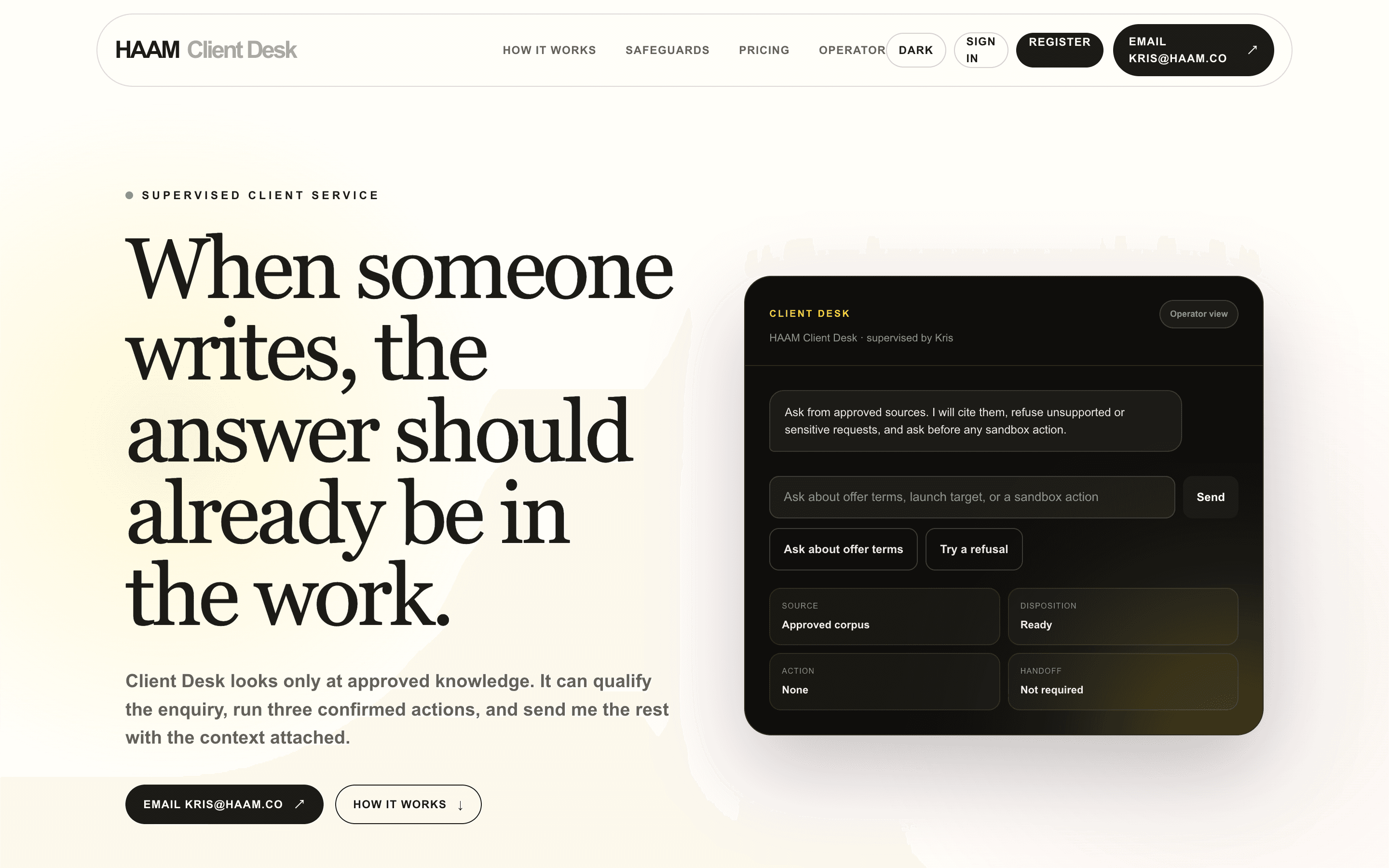
When someone writes, I want the desk to finish the turn from knowledge I have already approved: a cited answer, a refusal where the request is unsafe, or a confirmed sandbox action. What it cannot hold comes to me with the conversation attached.
eval cases
20Ordinary, incomplete, adversarial, and sensitive turns sit in a versioned harness.
sandbox actions
3prepare_brief, request_meeting, and create_ticket. Each waits for confirmation.
day retention
30In-memory store, optional localStorage key haam-client-desk-v1.
LLM in the loop
0The engine is deterministic. A model does not own the allowlist.
The job
I needed a desk that could answer from work I had already approved, refuse what it should not touch, and still bring the rest to me without making the visitor start over.
The loop had to be something a reviewer could complete against fixtures: a cited answer, a safe refusal, a confirmed bounded action, and a contextual handoff. No invented accuracy. No live client systems in this pass.
The starting vertical is HAAM Client Desk itself. The offer terms exist. Observed client volume does not.
The service loop
Each turn has to leave a record: what was asked, what source was used, whether an action ran, and why anything left the desk.
01
If the question sits in approved knowledge, the reply cites the source. The desk does not invent a second corpus.
02
Injection, sensitive, and unsupported requests stop here. The refusal is required, not a tone of voice.
03
prepare_brief, request_meeting, or create_ticket can run after an explicit yes. Unknown actions fail. The desk cannot grant itself new ones.
04
Commercial, unclear, or out-of-scope work becomes a structured note I can read in the operator view, including the conversation that produced it.
Design decisions
client.haam.co
Knowledge
I authored the sources and the policy together. If a fact is not in the approved set, it does not belong in the reply. That keeps the demo honest when a reviewer tries to pull it off-script.
Permission
The allowlist is server-side. Repeats use an idempotency key so a double click does not create a second meeting. Meeting slots are the two written ones, not a free calendar.
Handoff
The operator view exists so the rest of the work arrives as a record: who wrote, what they asked, what the desk already did, and why it stopped. Retention is thirty days.
The working stack
Engine
turn() in lib/desk/engine.ts. Policy, corpus, actions, and handoff are local modules with no provider in the loop.
Evidence
eval/cases.json covers ordinary, incomplete, ambiguous, stale, adversarial, sensitive, commercial, and unsupported mixes.
Surfaces
The public host is the same app tree. The visitor demo and the operator view share one store.
Host
Vercel Next.js. The in-browser engine does not take live client traffic.
In evidence
01A reviewer can complete cited answer, refusal, confirmed action, and handoff against fixtures
02Three sandbox actions stay behind confirmation and an allowlist
03Unsafe and unknown requests fail in tests instead of improvising
04Offer terms stay labelled as terms, not as observed results
Where it stops
There is no native app in this pass. Multi-tenant SaaS is out. I have not measured production load, and there is no independent accessibility audit in the evidence file.
A real client still needs a contract, a privacy arrangement, and an operator who will own the handoffs.
HAAM’s role
Offer terms, refusal and escalation, operator view, desk engine, evaluation harness, and local retention. Direct work, 2026.
How we learned
The working questions were concrete: what can be answered from approved knowledge, what must be refused, which actions can run only after confirmation, and what needs a human handoff. A versioned evaluation harness made those boundaries testable instead of leaving them as product copy.
Optional analytics. Google Analytics and Clarity load only if allowed; form, email, and chat content are excluded.