OsaaminenValitse kieli

World Cleanup Day / Global volunteer movement / 2017-2021

A global cleanup runs on invitations, not announcements.

World Cleanup Day asks millions of people in more than 180 countries to show up on one date. I built the digital layer around that ask: multilingual onboarding for the people organising locally, the hosting stack behind the public site, and an invite generator that let every volunteer recruit their own friends in their own language.

countries

180+

The reach of the movement is an operating condition, not a marketing line.

onboarding languages

55

Registration copy ran through a translation pipeline instead of hardcoded English.

share destinations

16

WhatsApp, Messenger, Viber, LINE, VK, SMS, email, and a plain download.

invite seasons

2018→2021

The same generator carried a new date and new artwork every year.

The recruitment problem

Nobody can centrally organise a hundred and eighty countries.

A one-day global cleanup is not a campaign a headquarters can run. Local leaders choose the sites, set the times, speak the language, and know who will actually turn up with a pair of gloves. The central digital layer has one job: let that happen fast and in public, without a bottleneck in Tallinn.

That changes what the website is. Less brochure, more onboarding system: register a country, a site, or yourself, reach the person organising nearby, and walk away with something you can send to a friend today.

The volunteer path

Find the day. Join a cleanup. Bring somebody with you.

  1. 01Register in your own language

    Onboarding asked for the minimum — an email or a phone number — in whatever language the volunteer actually reads.

  2. 02Make the invitation personal

    The generator composed a photo, a message, and the year's World Cleanup Day artwork into one square image.

  3. 03Send it where friends already are

    WhatsApp, Messenger, Viber, LINE, VK, SMS, email — or a download for the channels no API will ever reach.

Onboarding

Ask for one contact method, not a profile.

Somebody deciding to spend a Saturday picking up other people's rubbish should not have to complete a registration ritual first. The form accepted an email or a phone number, whichever the person had, and said so in plain language when neither arrived.

  • One required contact method instead of a full account
  • Interface copy translated through a Crowdin pipeline into dozens of languages
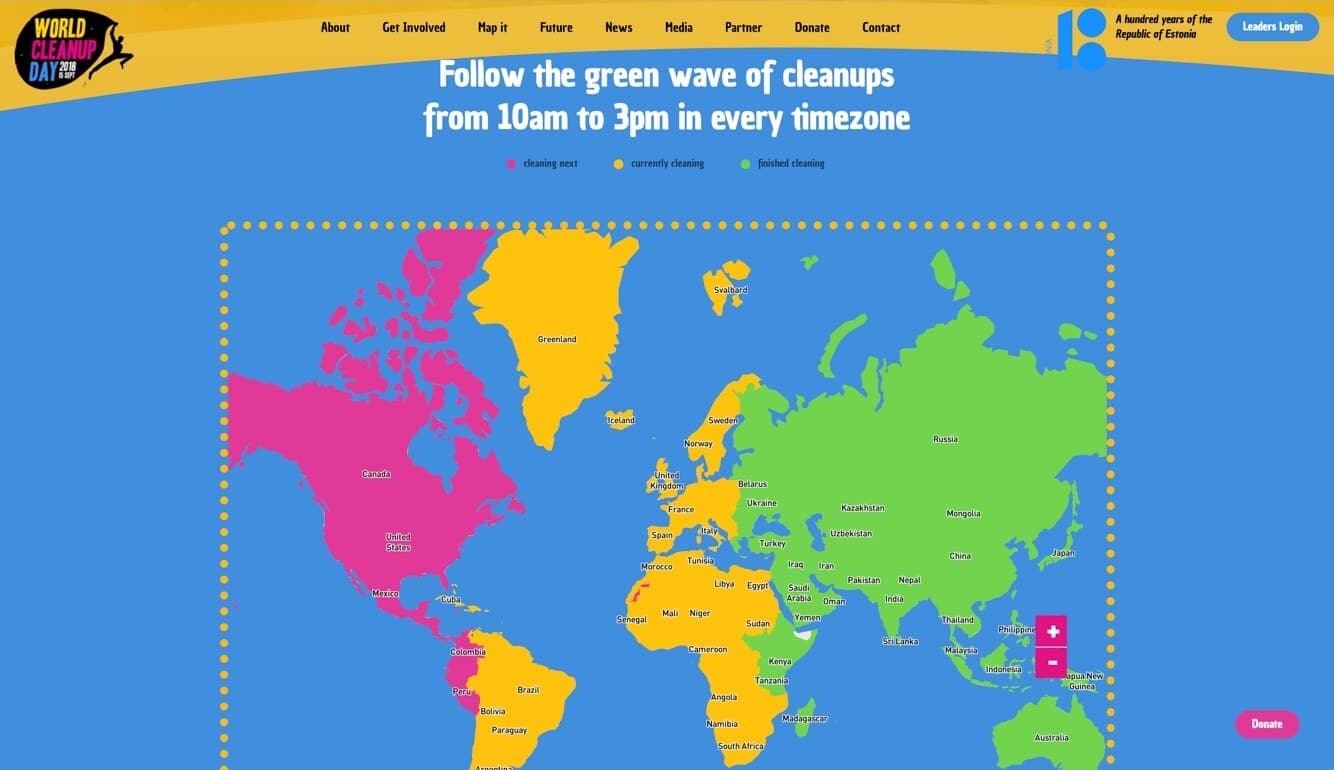
  • A live counter and a map made the scale of the movement visible while people joined

The invitation

Treat the invite as the campaign, not as a share button.

The strongest recruiter for a cleanup is somebody the volunteer already knows. So the invite got its own product: pick a photo, write the sentence you would actually say, and let the interface handle composition, branding, and the date.

  • A canvas composition instead of asking volunteers to open a design tool
  • Uploads capped and limited to common photo formats so phones could finish the flow
  • The year's logo and date swapped centrally, so each new season reused the same machine

Distribution

The share sheet has to match the country, not the head office.

The channel that matters in Indonesia is not the channel that matters in Honduras, Nigeria, or Estonia. A generator that only spoke Facebook would have failed most of the movement, so distribution was designed as a wide set of destinations with honest fallbacks.

  • Sixteen destinations covering the messengers people in each region actually use
  • A featured gallery so strong invitations recruited more invitations
  • Download and copy-link fallbacks for everything an API cannot reach

Infrastructure

Boring hosting, so one date in September does not break the movement.

Attention for World Cleanup Day arrives as a spike, not a stream. The editorial site ran on a provisioned WordPress stack with staging, deploys, and rollback as routine moves, while the interactive apps were deployed separately so a rush on one could not take down the other.

  • Staging and production built from the same provisioning playbooks
  • Rollback treated as a normal operation, not an emergency
  • Interactive apps isolated from the editorial site they promote

After the day

A movement's traffic arrives once a year. Plan for it or lose it.

Everything about this product is seasonal. Registrations climb toward one date, invitations peak in the final fortnight, and then the whole system goes quiet until the next cleanup is announced. Designing for that rhythm means the yearly rollover — new date, new artwork, new copy — has to be cheap enough that nobody dreads it.

The durable value is not any single interface. It is that a volunteer in a country the team has never visited could register, understand what is happening, and produce a shareable invitation in a language the organisation does not speak.

  • One translation pipeline instead of country-by-country site forks
  • Seasonal content swaps that do not require rebuilding the product
  • Public proof of participation, which is the movement's real recruitment engine

HAAM’s role

I built the parts that turn attention into participation.

Product, interface, and operations

HAAM's role covered product structure, interaction design, multilingual content pipelines, frontend and backend implementation, hosting and deployment infrastructure, and the yearly rollover from one cleanup date to the next. World Cleanup Day visual identity by Let's Do It World.

Next case study

A theatre site rebuilt around the moment somebody needs a ticket.

View Viirus

Help improve this website?

Optional analytics. Google Analytics and Clarity load only if allowed; form, email, and chat content are excluded.