Le Tre Meraviglie / Intergenerational social design / 2021

Technology was the barrier. So the over-60s became the designers.

Le Tre Meraviglie was a Trentino response to pandemic isolation: three products co-created, entirely over Zoom, by people over 60 and the students and young professionals working with them. HAAM hosted the design placement, worked with the team on interaction design and design thinking, and led the third Meraviglia—the project's own online platform—from brief to presented interface.

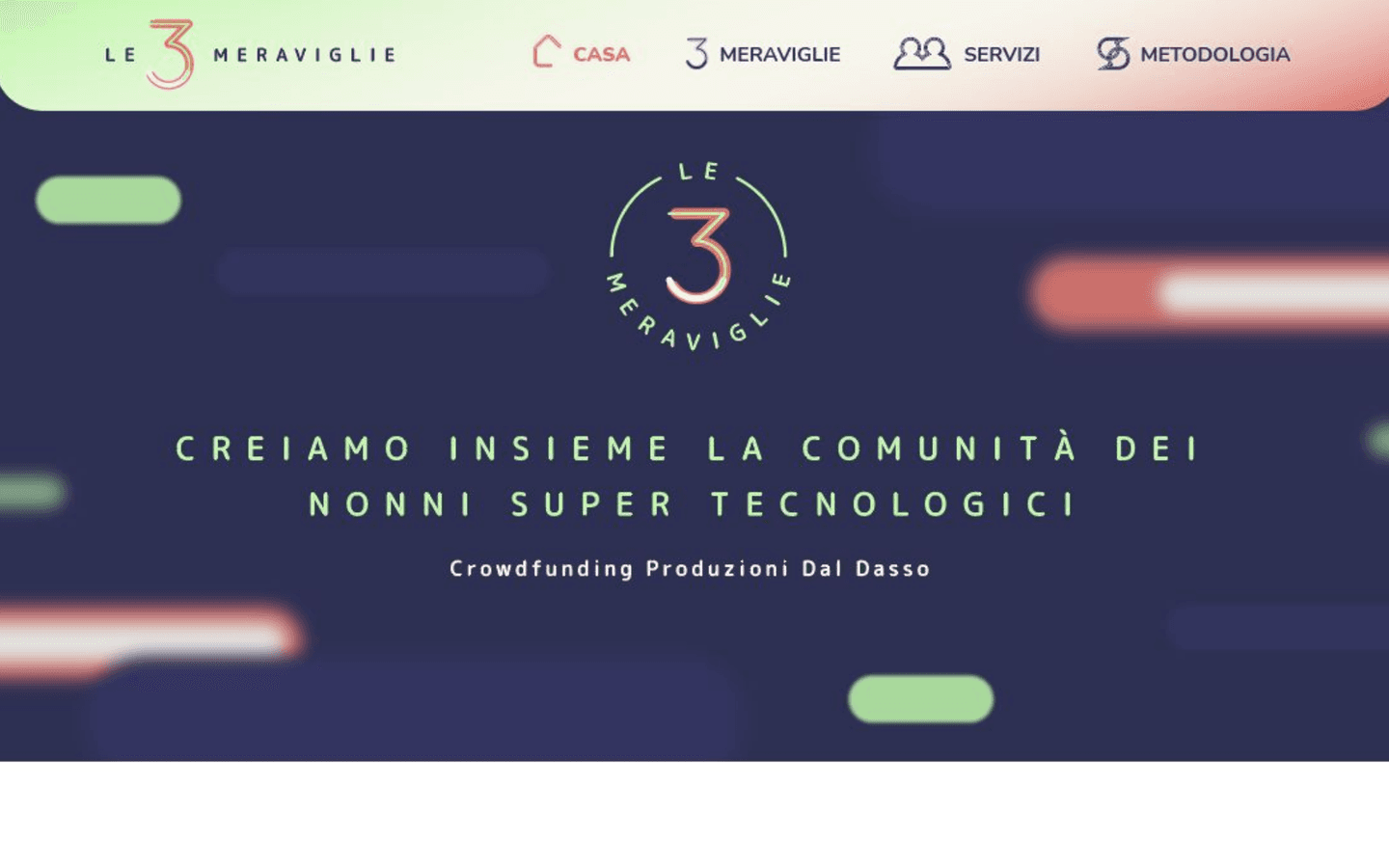
Le Tre Meraviglie homepage design with the project mark and the line “Creiamo insieme la comunità dei nonni super tecnologici”.

meraviglie

3

A scent-based therapy game, a Trentino board game, and an online platform.

over-60 consultants

25

Participants over 60 were briefed as consultants, not enrolled as students.

public presentation

1 Oct 2021

The work was shown to the community on the International Day of Older Persons.

students on placement

32

Two Trentino institutes—one for design, one for IT—ran their internships inside the project.

The social problem

Isolation was the symptom. The generation gap was the mechanism.

Covid removed the associations, the meetings, and the ordinary contact that kept people over 60 in public life in Trentino. What remained was a phone or a tablet that many of them had never been given a reason to trust. Treated as a training problem, that produces courses nobody attends.

Le Tre Meraviglie inverted it. The over-60s were not the audience for a digital-skills programme; they were the source and the reviewers. Their memories, the smells of the region, the games they built out of bottle caps, and the daily obstacles they described became the brief, and a team of young designers had to turn that material into three real products.

How a Meraviglia was made

Start from memory. Write the brief from it. Prototype with the people who asked.

  1. 01Art-therapy workshops

    On Zoom, participants worked with scent, salt dough, and writing. The sessions produced poems, stories, and video biographies.

  2. 02Briefs written from the material

    Three briefings turned the recurring themes—scent, play, and staying connected—into design challenges with real constraints.

  3. 03Prototypes reviewed by the over-60s

    Concept, technical sheet, and prototype were each presented back to the participants, who were the primary reviewers at every stage.

Teaching

Give the students a vocabulary before you give them a brief.

The design team was made of students, and the first sessions were deliberately not about the project. We started with affordance—why one object explains itself and another does not—and with the design-thinking loop, so that empathy and definition were not skipped in the rush to draw something.

  • An everyday object that works and one that fails as the opening exercise
  • Empathise, define, ideate, prototype as the working structure
  • Interview homework: find three or four problems the over-60s actually have

Research

Ask about childhood, not about technology.

The fastest way to get a useless answer from someone over 60 is to ask what they want from an app. The guidance was to ask wide questions about their days and their childhoods and to listen for the friction. That is where the scents, the bottle-cap races, and the frozen phone nobody knows how to restart came from.

  • Broad conversation before any product question
  • Frustration recorded as design evidence rather than as complaint
  • The people running the interviews were the people who had to design for them

The third Meraviglia

The platform had to carry the project after the funding ended.

The first two Meraviglie were objects: Il Gioco Terapeutico, built around essential oils, and Alla Scoperta del Trentino, a Gioco dell'Oca that walks players across the region to the Castello del Buonconsiglio. The third—La Piattaforma degli Adulti Digitali—had to hold the rest together: a public home for the story, the courses, the methodology, and the over-60 consultants themselves.

  • Four sections: the project, the three Meraviglie, the courses, and the downloads
  • Video biographies of the over-60 consultants as a browsable library, reachable by schools
  • Course listings with open registration instead of a closed archive

Interface

Design for a reader who is still deciding whether the internet is worth it.

Part of this audience joined their first video call in 2021. That set the rules: generous type, a rounded and unintimidating typeface, one obvious action per section, and colour used to separate the site rather than to decorate it. The palette came from the L3M mark and the organic colours of the Trentino landscape, which the briefs had asked for from the start.

  • Nunito and large type sizes across the whole layout
  • One clear action per section—watch, register, download
  • Brand colour used structurally so sections stay easy to tell apart

After the presentation

The point was not three prototypes. It was that the group could keep going.

The work was presented publicly on 1 October 2021 and the products were real: a game, a board game, and a website. The more durable outcome was the group itself—participants who had started the year needing telephone support to join a call and ended it sharing screens and reviewing design work.

That is also the honest limit of a project like this. Funding ends, students graduate, and a site with courses on it needs somebody to publish the next course. The structure was built so the association could do that without a designer in the room. The platform ran until roughly 2023; the domain has since lapsed, and the link above points to an archived capture.

  • A site structure the association can update without redesigning it
  • Methodology published as downloadable material instead of staying internal
  • Over-60 consultants named and contactable, including for schools

HAAM’s role

I hosted the design team and led the third Meraviglia.

Product, interface, and operations

HAAM (Haamer Ventures OÜ) was the host organisation for the design internship, contributed the interaction-design and design-thinking teaching for the student team, and led the online platform from brief through sitemap to the interface presented at the final event. Project by Associazione Tremembè with Akoma Collective, H2O+, Erickson, and six local senior associations; artistic coordination by Cindy Baptista; project coordination by Michela Boldrer. Funded by the Italian Ministry of Labour and Social Policies with the Autonomous Province of Trento.

Next case study

A theatre site rebuilt around the moment somebody needs a ticket.

View Viirus

Help improve this website?

Optional analytics. Google Analytics and Clarity load only if allowed; form, email, and chat content are excluded.