symposiums built
2Welcome Stranger! in 2016 and Naked SPACE in 2017, each with a different structure to solve.


Cultural institution · Symposium platform · 2016-2017
SISU is the interior architecture symposium of the Estonian Association of Interior Architects — a client HAAM built for across several years: the association's own website, two editions of the symposium, and the journal it publishes for the profession. Years later, when the hosting was long gone, HAAM recovered the symposium sites.
symposiums built
2Welcome Stranger! in 2016 and Naked SPACE in 2017, each with a different structure to solve.
speakers hosted
24Fifteen in Tallinn in 2016, nine across Lucerne and Tallinn in 2017, each with a page in every language.
languages in parallel
3Estonian and English from 2016, German added in 2017, each maintained as its own edition.
pageviews in the 2016 season
11,284Roughly a quarter of everything read across the association's website that spring and summer.
The brief
SISU is organised by the Estonian Association of Interior Architects together with the interior architecture department of the Estonian Academy of Arts. Each edition takes a theme and builds a programme of international speakers, films, and moderated discussion around it.
In 2016 the theme was nomadism, and the site's problem was presence. Welcome Stranger! ran for three days in the Hobuveski in Tallinn, and the brief was to make the website feel like something was happening: a live blog through the event, a schedule that knew what time it was, and a card on the association's own homepage naming whoever was currently on stage.
In 2017 the theme was what happens to a building when its original purpose runs out, and the site's problem was structure. Naked SPACE ran in two countries simultaneously, in three languages, with some sessions shared between the cities and some belonging to only one. A visitor should never have to work out which half of the programme applies to them.
The editions
The visual identity carried across, but the structure underneath was designed for the specific shape of each symposium.
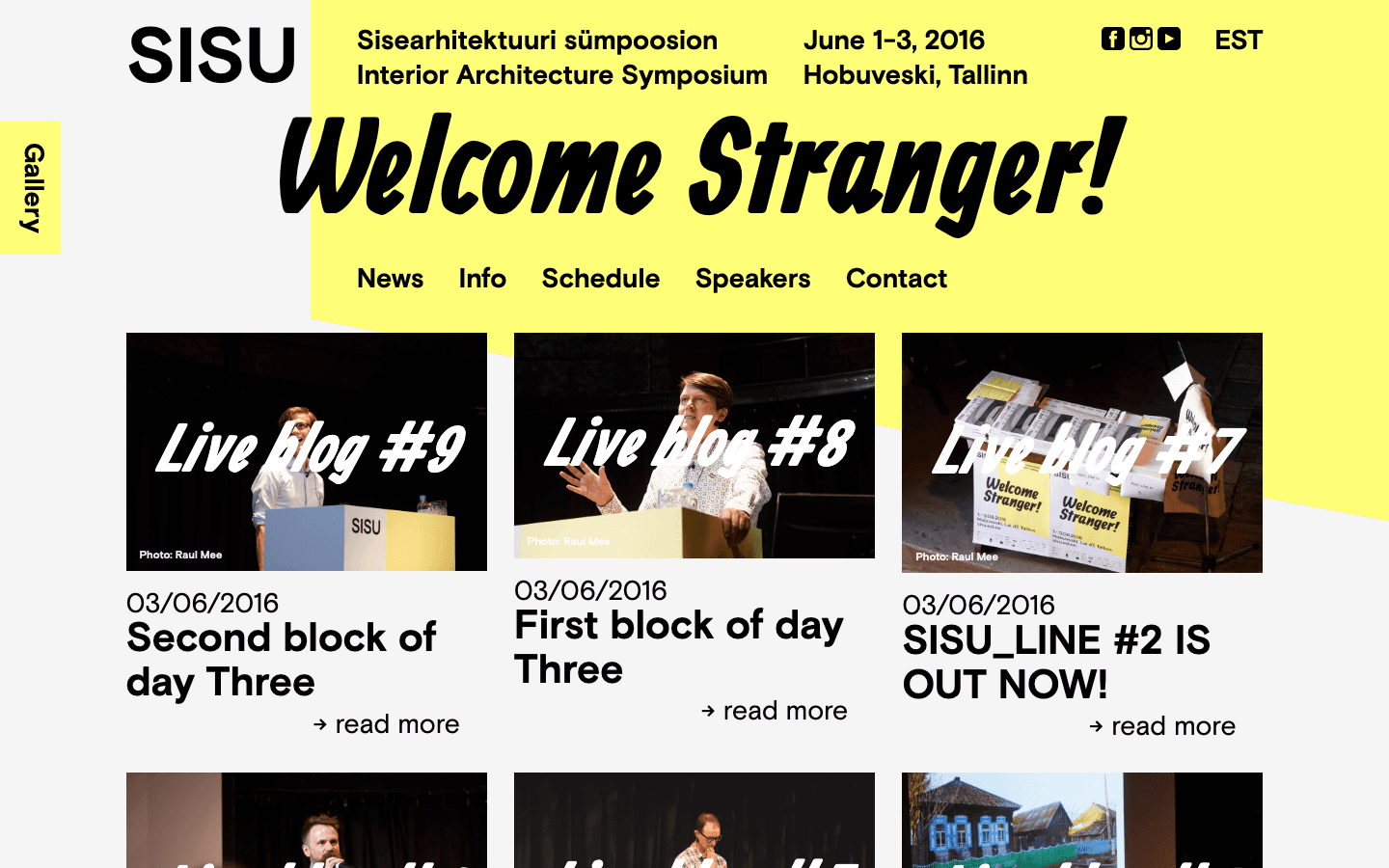
The third SISU took nomadism as its subject: movement that is sometimes chosen and sometimes forced, and what it does to the idea of a place and a home.
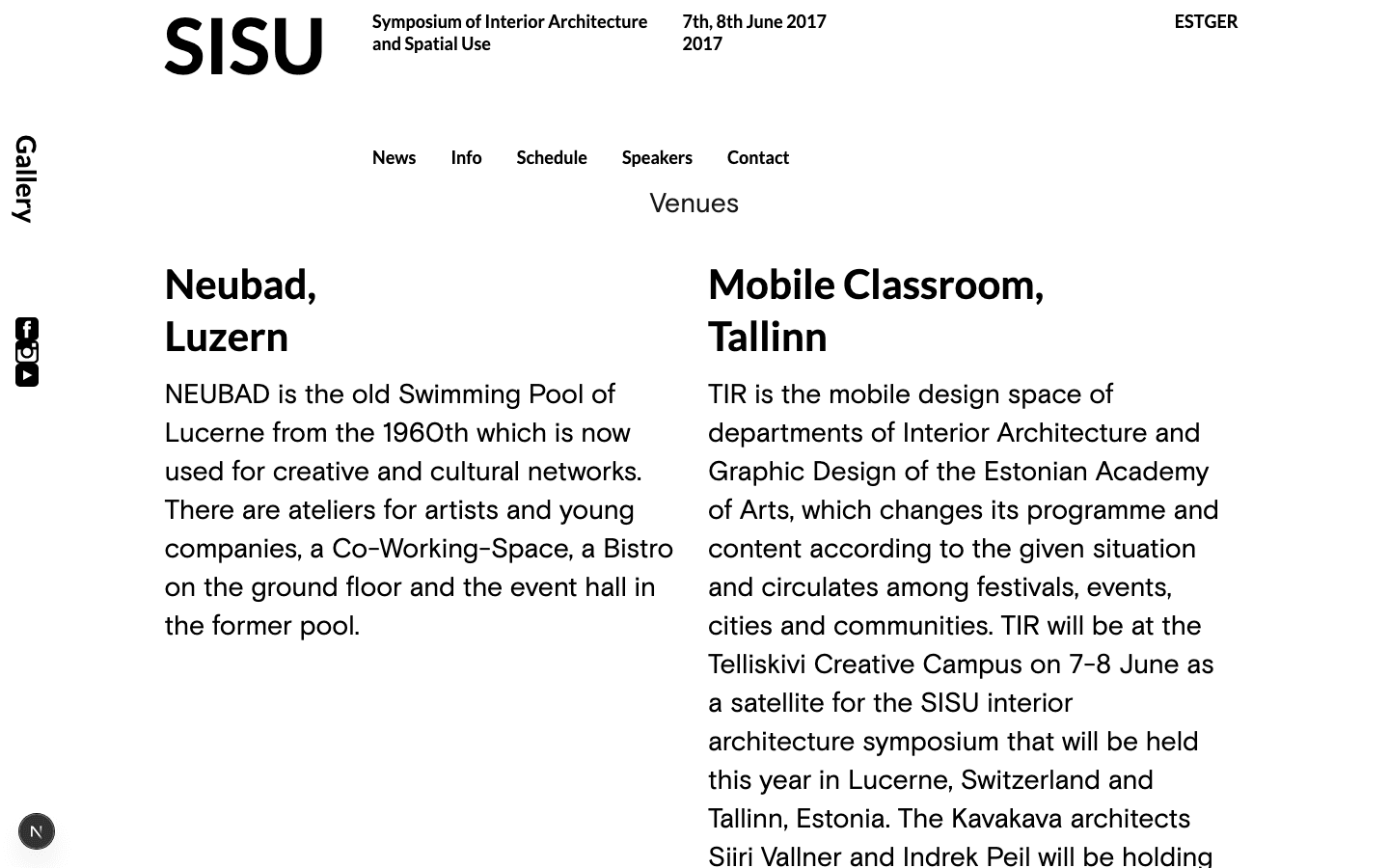
The fourth SISU asked what happens to a building when its original purpose runs out, and held itself in two reused spaces in two countries to make the point.
One client, several products
An association website, a two-day event in two countries, and a journal for the profession are three different products for the same people.
Before the symposium
Before there was a symposium to build, there was the association itself. HAAM built its website first, and that is where the SISU work started. It has since been replaced by a newer site HAAM did not build.
Build: HAAM
Alongside the symposium
The association also publishes for its profession. SISU_LINE gathers writing on the identity of the interior architect, design education, and the standing of the field in Europe — thirteen articles in Estonian and English, by practitioners and academics, with its own way back into the symposium.
Design: AKU · Build: HAAM
Earlier editions
The symposium already existed before HAAM's involvement. Those two editions are kept in the same archive and are part of the story, but they were built by other people and are not claimed here.
Built by others
Who it was for
A symposium site is read under pressure: while travelling, between sessions, and years later by someone trying to remember what was said.
01
In 2016 the site had to convey that something was happening right now, in a hall in Tallinn, to people reading from somewhere else. That is a different job from listing information.
02
In 2017 a visitor in Estonia and a visitor in Switzerland were looking at the same symposium but making different practical decisions about travel, venue, and which sessions were actually in front of them.
03
A small association team, working in Estonian, needed to publish and correct the site themselves during an event where the programme changes up to the moment it starts.
04
Two symposiums produced a permanent record. The schedules, the talks, the venues, and the photography had to stay legible long after both events closed.
Design decisions
Time, language, city, and editorial ownership were modelled as properties of the content rather than as separate copies of the website.
2016 · Presence
The proposal for Welcome Stranger! argued that a symposium site should feel like a live broadcast rather than a brochure. That produced a running live blog, a schedule aware of the current time, and a card on the association's homepage naming whoever was on stage and who was next.
2016 · Language
Estonian and English were routed separately down to the URL, so an Estonian reader moved through /kava and /esinejad while an English reader moved through /schedule and /speakers. The language is part of the address rather than a setting applied on top of one.
2016 · Editing
The admin interface was labelled in Estonian, field by field, for the association staff who would actually use it. Speakers, schedule, news, and films were editable content types, which is why the site could be corrected during the event without a developer.
2017 · Two cities
Naked SPACE was not two events with two websites. It was one programme, partly shared and partly local. Every entry carries its own city scope, so the same published schedule reads correctly whether you are standing in the Neubad or at Telliskivi.
2026 · Preservation
Both sites were Meteor applications backed by hosted databases that no longer exist. Years later the 2017 content survived only as a physical database snapshot. Recovering it meant reading that snapshot back, exporting the collections, and rebuilding the site as a static archive.
Then and now
What was built for each symposium and what keeps it readable today are different systems holding the same material.
2016
A reactive application with a content system localised for the association's own staff, running as part of the association's website.
2017
A standalone trilingual site with its own admin, deployed to a single server through Meteor Up and Docker.
Media
Speaker portraits, venue photography, and the two-city gallery held outside the application, which is why the imagery is still intact today.
2026
The 2017 content, exported from the original database and served statically, so the symposium can be read without restoring any infrastructure.
What the projects produced
Both symposiums ended years ago. The material they generated is still complete, still structured, and still possible to read.
Organisers
Estonian Association of Interior Architects · Estonian Academy of Arts · Lucerne University of Applied Sciences and Arts
Curators, 2017
Sibylla Amstutz (Lucerne) · Tüüne-Kristin Vaikla (Tallinn)
Graphic design
Stuudio Stuudio (SISU 2017) · AKU (SISU_LINE)
Web development
Kris Haamer / HAAM
The long view
These sites were built for three days and for two days. What they left behind is a record of two international symposiums: schedules, talks, a film programme, venues in two countries, and a hundred and seventeen photographs. None of it was designed to be permanent, and all of it nearly disappeared with the hosting.
Recovering the 2017 site took reading the content back out of a raw database snapshot, separating the public material from personal accounts, and rebuilding it as a static archive that depends on nothing. That is the part of the work that lasts, and it is the reason this case study can still show you the event.
How we learned
Speaker records, programme changes, languages, live-blog activity, venues, and real usage across two symposiums created a live research environment. Observing those states helped separate what people need during the event from what belongs in the long-term archive.
Evidence trail
Good interaction design should be traceable upstream. Depending on the project, that upstream work might be interviews, co-design, fieldwork, archive work, testing, analytics, or operations. Here is the shortest version of the chain from evidence to decision.
01
Two symposiums produced 24 speaker records, three languages, a 33-post live blog, two-city activity, and 11,284 pageviews in the 2016 season.
02
Time, language, venue, speaker context, and live editorial state matter more during an event than a static brochure hierarchy.
03
Model speakers, programme items, venues, languages, and live posts as connected content that can change by edition.
04
The site can behave as a live event surface during the symposium and remain a coherent archive afterwards.
Optional analytics. Google Analytics and Clarity load only if allowed; form, email, and chat content are excluded.