objects
100One object for every year of Finnish independence


100 Objects from Finland / Digital exhibition / 2016-2018
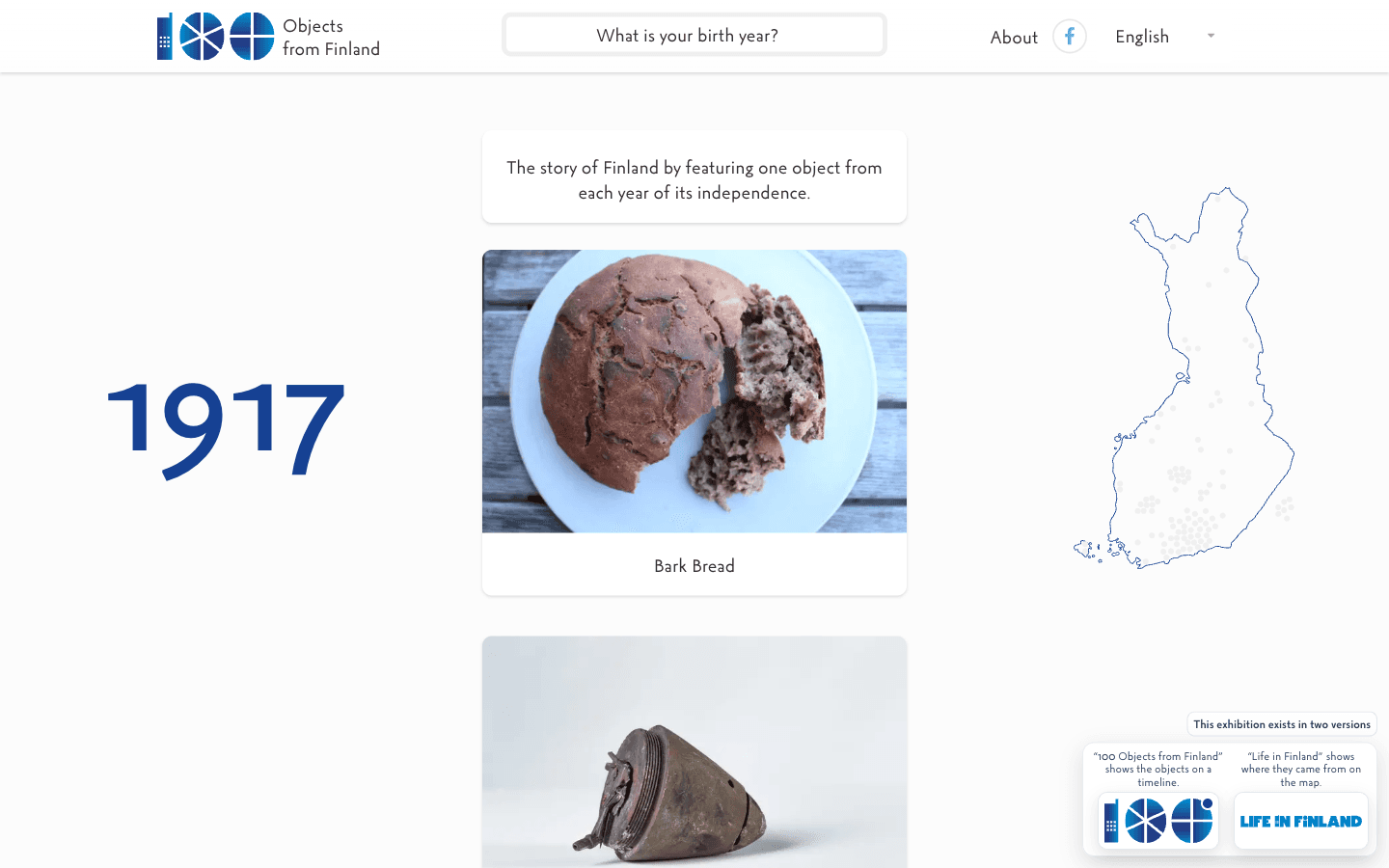
For the Finnish Institute in Estonia, HAAM designed and built an online exhibition that connected one object from every year of Finnish independence into a personal, explorable journey through time and place.
objects
100One object for every year of Finnish independence
languages
15One structured collection made available across borders
tour cities
5Helsinki, Tallinn, Oslo, Madrid, and Riga
connected views
3Timeline, full-screen map, and complete overview
The product premise
Recovered process artifact / September 2016
The original proposal already defined the core behaviour: scroll backwards to 1917, keep the year visible, change the object location on the map, expand the map to the full screen, and zoom out to see the complete collection.
Personal entry point
The prompt “What is your year of birth?” brought the matching object to the foreground. Instead of asking visitors to begin with an unfamiliar archive, the experience began with a year they already cared about.
Time and place
As visitors moved backwards through time toward 1917, the year remained a stable orientation point while the object’s location changed on the map. Motion carried information: it showed that each object belonged to both a moment and a place.
Change of scale
A small map expanded to fill the screen, while a zoom-out control revealed all one hundred objects at once. The product supported close reading, spatial exploration, and rapid overview without turning them into disconnected experiences.
Outcome / Long-term stewardship
The exhibition travelled through five European cities in 2017 and 2018, while the online collection remained available beyond the tour. The material later continued through Life in Finland, and HAAM returned years after launch to archive and restore the sites rather than treating them as disposable campaign pages.
Collaboration
The curators shaped the collection and exhibition story. HAAM was responsible for turning that material into the online product and carrying the digital experience from interaction concept through implementation and later preservation.
Next case study
How we learned
We worked from object records, dates, locations, stories, image credits, ownership, and multilingual content to understand how the same century could be entered through different paths without fragmenting the archive.
Evidence trail
Good interaction design should be traceable upstream. Depending on the project, that upstream work might be interviews, co-design, fieldwork, archive work, testing, analytics, or operations. Here is the shortest version of the chain from evidence to decision.
01
100 objects, a century of dates, locations, and 15 language editions formed one structured collection.
02
Visitors needed to enter the same material through time, place, or recognition without creating separate archives.
03
Use one object model to power the timeline, map, overview, and language editions.
04
One collection can be explored as history, geography, or individual objects without duplicating the underlying content.
Optional analytics. Google Analytics and Clarity load only if allowed; form, email, and chat content are excluded.