OsaaminenValitse kieli

Narva Art Residency / Artist residency and public culture / 2021-Present

A residency is not one journey. The website should stop pretending it is.

NART connects international artists, Narva residents, schools, visitors, researchers, partners, and the Estonian Academy of Arts from a historic site on the Estonian-Russian border. I designed paths for those different relationships instead of forcing them through one permanent open-call funnel.

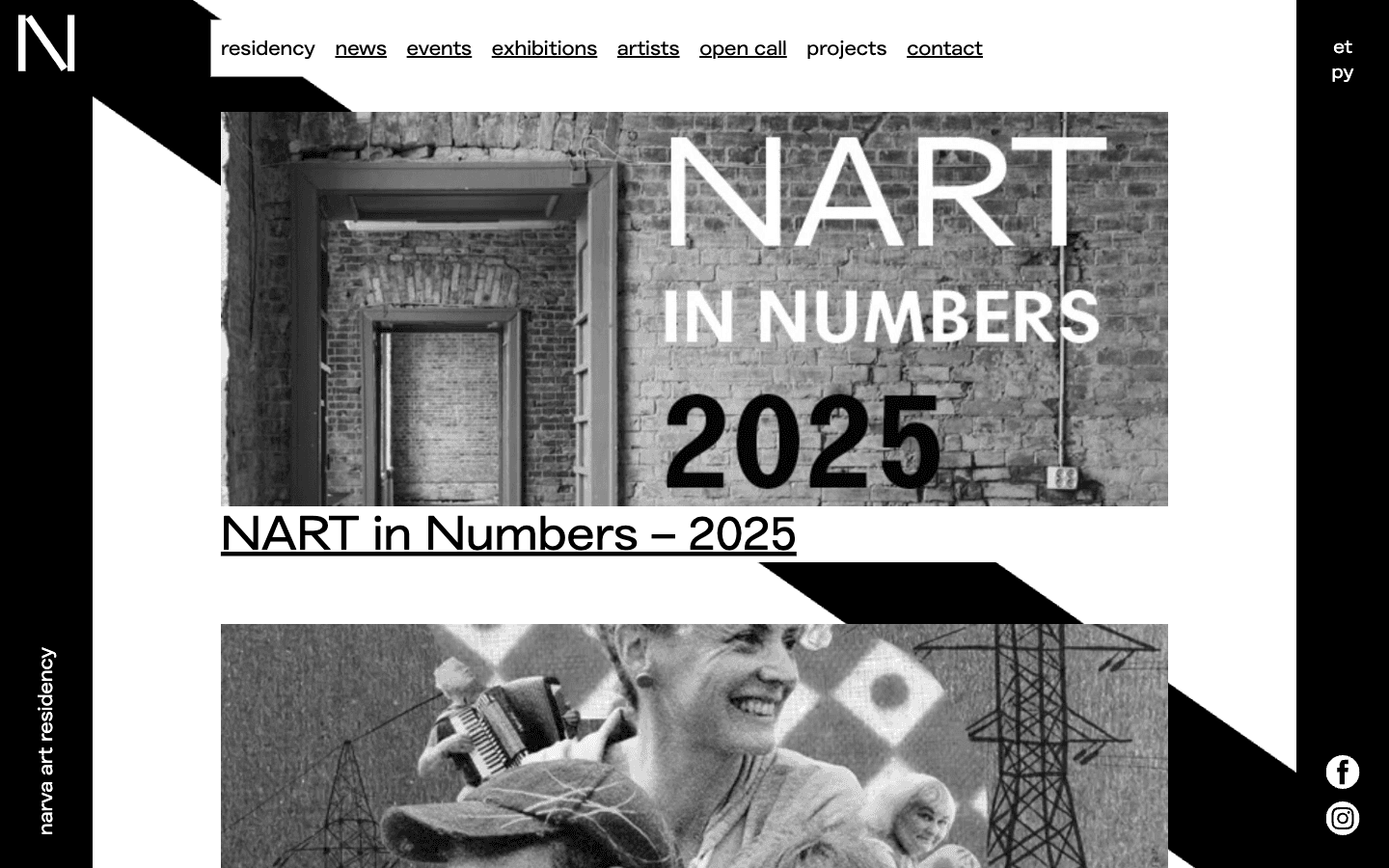
Narva Art Residency website showing open calls, artists, events, exhibitions, and projects.

founded

2015

The platform combines residencies, exhibitions, talks, and education.

languages

3

English, Estonian, and Russian serve different relationships to place.

context

Border city

Narva and Kreenholm are part of the product story, not background decoration.

public role

Year-round

Open calls are only one moment in an active cultural programme.

The platform problem

An applicant, a resident, and a neighbour are not looking for the same NART.

Applicants need eligibility, dates, facilities, expectations, funding conditions, and a trustworthy submission path. Selected artists need practical information. Local residents may be looking for an exhibition, workshop, school programme, community garden, or simply a reason to enter the building.

A residency website easily becomes seasonal: loud during an open call, empty afterwards. NART needed a structure where artists, events, education, projects, the house, and Narva’s context could keep the institution active between application deadlines.

The audience model

Apply, take part, visit—or understand what happened.

  1. 01Applicants verify the opportunity

    Open calls make status, fit, dates, support, expectations, and submission requirements explicit.

  2. 02Audiences find public activity

    Events, exhibitions, education, and projects give local and visiting audiences direct routes in.

  3. 03The archive carries relationships forward

    Artist and project records connect a temporary residency to its public afterlife.

Audience paths

Do not make everybody enter through the funding application.

Residencies often let the open call swallow the whole website. I separated the needs of applicants, current artists, public audiences, educators, and partners while keeping their relationships visible.

  • Residency information and public programming have distinct entry points
  • FAQ and service content support high-intent practical tasks
  • Artists, projects, events, and exhibitions remain connected

Open-call states

A deadline is a product state, not a sentence hidden in a paragraph.

Calls open, change, close, select participants, and become archive records. I treated those moments as explicit states so a visitor can understand whether to apply, wait, read the result, or explore an earlier programme.

  • Open and closed calls are visually and verbally distinct
  • Deadlines and eligibility appear before long curatorial context
  • Past calls remain useful without masquerading as current opportunities

Place

Use Narva as context, not as exotic wallpaper.

Kreenholm, the border, local languages, industrial history, and community relationships shape what the residency can responsibly do. I kept place connected to programmes, practical information, and public work rather than isolating it in an atmospheric About page.

  • The house and Kreenholm history support orientation
  • Local projects sit beside international residency work
  • Language choices acknowledge different relationships to Narva

Institutional memory

Temporary residencies need permanent links.

An artist may stay for weeks, but the project, documentation, collaborators, and local relationships can remain valuable for years. The content model connects people, calls, events, exhibitions, education, and projects so the archive explains more than a date.

  • Artist records connect to the work produced around the residency
  • Projects gather activity across multiple seasons
  • Archives help future applicants and partners understand the institution

Between open calls

The website has to prove the institution is alive when nobody is applying.

NART runs exhibitions, school residencies, workshops, talks, community programmes, and experiments beyond its main residency cycle. The interface gives that activity durable homes instead of letting every initiative become an isolated announcement.

The operational test is whether the team can publish a new call, event, artist, or project without rebuilding the navigation each time. The content model creates those repeatable moves and keeps the relationships between them visible.

  • Reusable structures for calls, artists, events, exhibitions, and projects
  • Public pathways that remain active outside application season
  • Archives that support accountability, memory, and future participation

HAAM’s role

I designed for a programme that keeps changing without losing its shape.

Product, interface, and operations

HAAM’s role covers product structure, information architecture, interaction design, multilingual content patterns, responsive implementation, and ongoing product thinking. Graphic design by Jaan Evart.

Next case study

A theatre site rebuilt around the moment somebody needs a ticket.

View Viirus

Help improve this website?

Optional analytics. Google Analytics and Clarity load only if allowed; form, email, and chat content are excluded.